




Table of Contents
▼- Aeronautical Engineer Resume Examples & Writing Guide
- 1. Which format to choose for an aerospace engineering resume?
- 2. Write an eye-catching resume summary or objective.
- 3. Skills to include in your aeronautical engineering resume sample.
- 4. List your work experience aerospace engineering.
- 5. Use of action words in your aeronautical resume effectively
- 6. An effective way to list your educational background in a resume
- 7. Make sure to always proofread
- Common mistakes to avoid on an aeronautical engineer's resume
- Conclusion
Aeronautical Engineer Resume Examples & Writing Guide
Your knowledge in aerodynamics and propulsion systems is remarkable, but converting that into a resume can be challenging. It is vital to convey your expertise with design software and effectively showcase your successful projects. Given that employers are keen to quickly understand your accomplishments, achieving the right balance between technical specifics and clarity is essential.
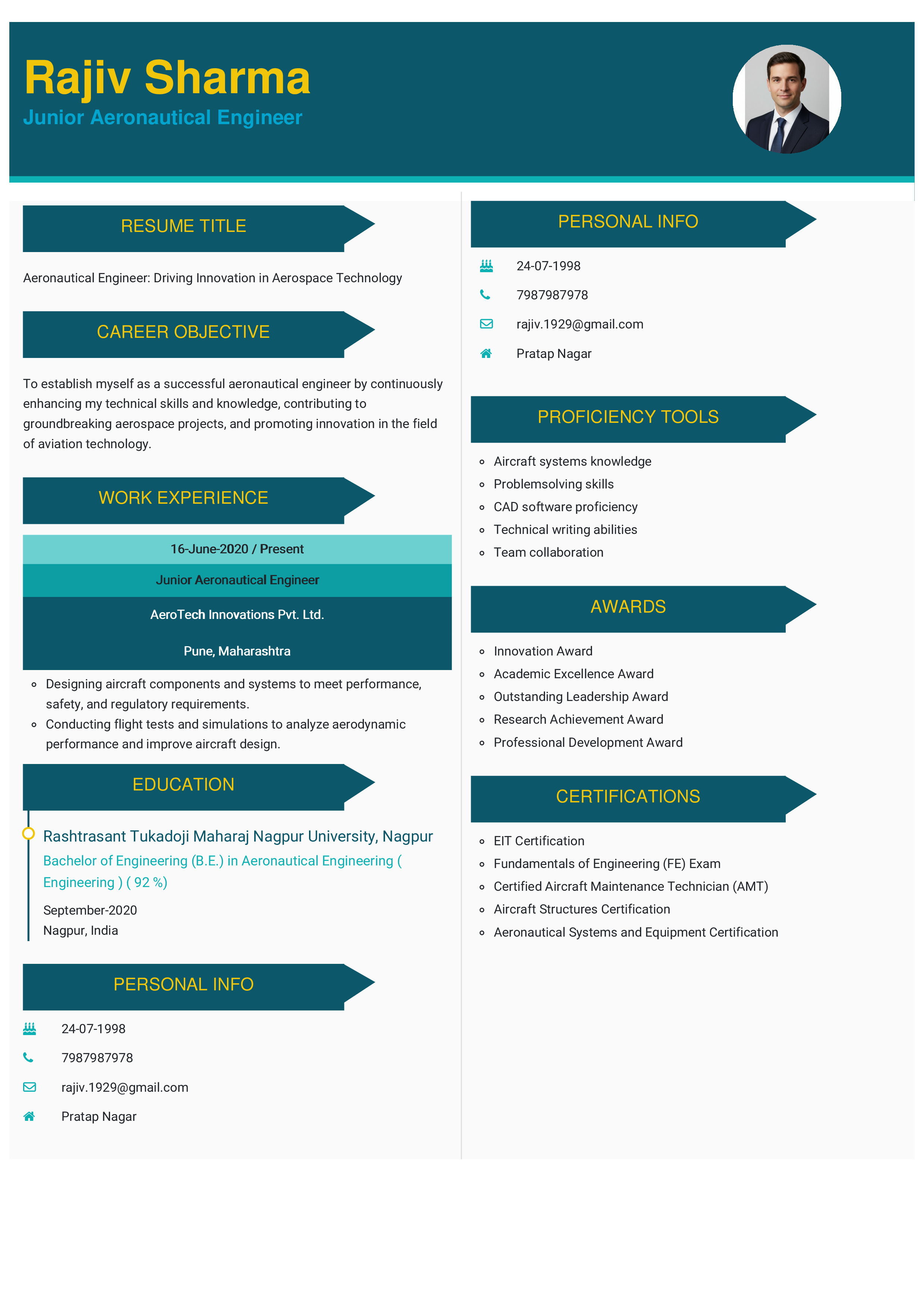
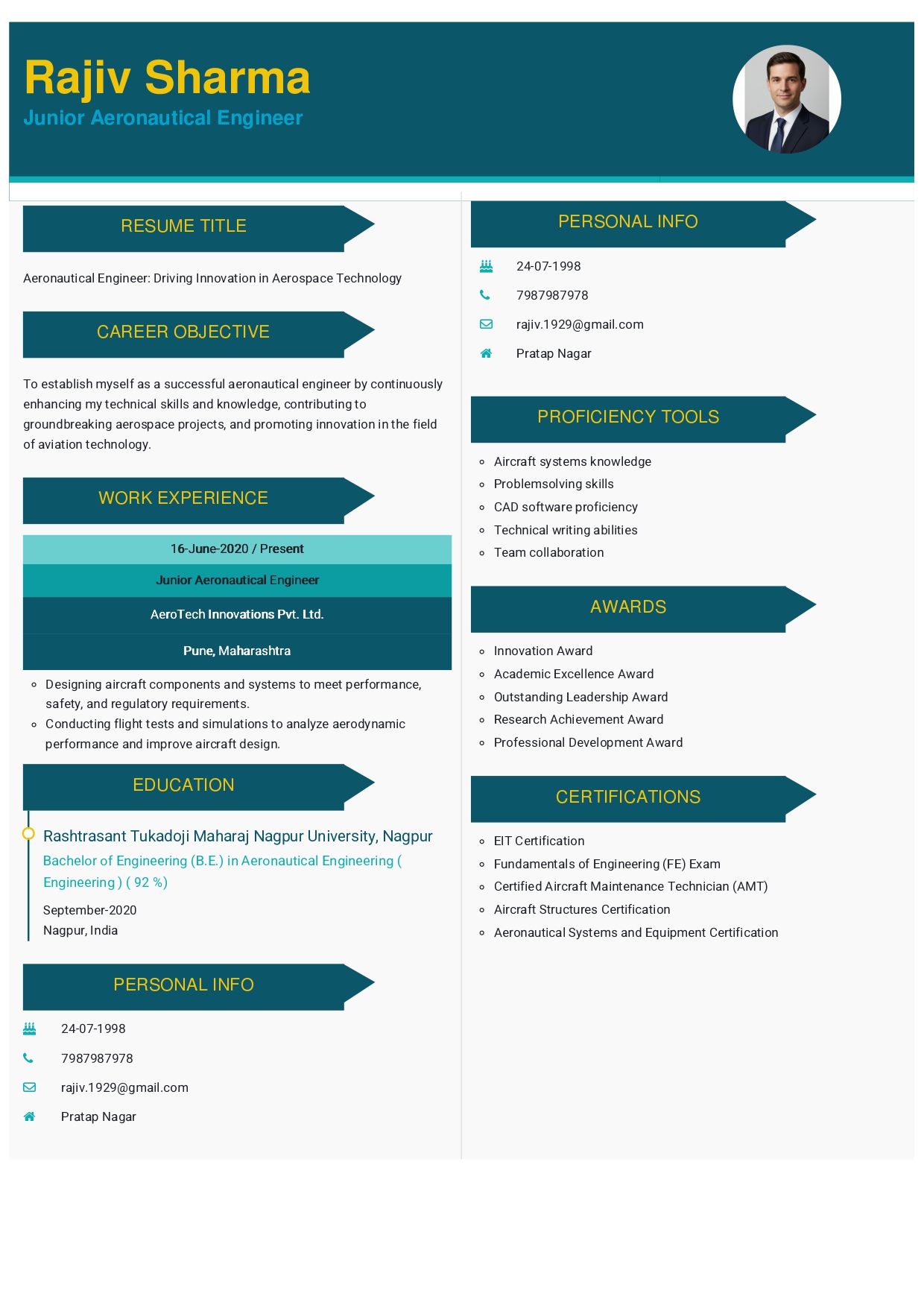
To facilitate this process, utilizing an aeronautical engineering resume template can offer a systematic approach for organizing your skills, experiences, and achievements. This ensures that your resume accurately reflects the accuracy and creativity inherent in your work within aerospace engineering.
A well-organized template enables you to tailor your resume, highlighting your specific contributions to fields such as aerodynamics, systems integration, or space exploration. In a competitive industry, your objective is to ensure that your resume stands out. By aligning your accomplishments with the position you are pursuing, you produce a document that not only attracts attention but also truly excels.
1. Which format to choose for an aerospace engineering resume?
When creating your aerospace engineer resume, opting for the reverse-chronological format is a strategic decision. This approach emphasizes your latest positions and accomplishments, allowing potential employers to quickly recognize your career advancement and current skills. The positions you have held and the abilities you have developed over time are best presented in this format, as it clearly and logically outlines your career trajectory.
Nevertheless, if you do not possess formal work experience in aerospace engineering, you may want to explore one of the following alternative formats:
-
Functional Resumes: This format is particularly effective for current students or recent graduates who have a substantial educational background but limited professional experience.
-
Hybrid Resumes: This format is ideal for engineers transitioning to new career paths or disciplines, as well as applicants re-entering the workforce after a career break.
2. Write an eye-catching resume summary or objective.
This section is frequently the first element that hiring managers encounter. A well-formulated statement effectively conveys your identity and the value you provide, thereby creating a powerful first impression.
Resume summary
The summary within a resume offers a succinct overview of your professional history, essential skills, and accomplishments. It is generally utilized by candidates who possess some experience in the industry.
Structure:
- Commence with your job title or a phrase that encapsulates your professional persona.
- Highlight your core competencies, including technical abilities, software expertise, or particular domains of aerospace engineering.
- Concise mention of any notable achievements or experiences that distinguish you from others.
Resume objective
A resume objective articulates your career aspirations and what you intend to accomplish in the position for which you are applying. The objective in a resume is particularly suitable for individuals entering the workforce, changing careers, or wishing to highlight their career ambitions. It emphasizes how you intend to add value to the employer.
Structure:
- Clearly define your objectives for employment in your forthcoming role.
- Specify what you can contribute.
Customize the aeronautical engineer resume objective to align with the company or position you are pursuing.
3. Skills to include in your aeronautical engineering resume sample.
Incorporating Aerospace engineering skills for resume is essential, as it allows you to highlight abilities that may not be addressed in your work experience section or resume summary. When determining what skills do aeronautical engineers need to feature in their resume, it is vital to select a combination of both technical and interpersonal skills. Technical skills refer to the more intricate, acquired abilities developed through education and training, whereas interpersonal skills pertain to your emotional intelligence and capacity to comprehend the people and environment surrounding you.
Keeping in mind, here are 10 examples of each:
Hard skills-
- Aerodynamics Analysis
- Computational Fluid Dynamics (CFD)
- CAD Software Proficiency
- Structural Analysis
- Systems Engineering
- Thermal Analysis
- Avionics Systems
- Navigation Systems
- Aeronautical Testing
- Robotics and Automation
Soft skills-
- Problem-Solving
- Critical Thinking
- Team Collaboration
- Effective Communication
- Adaptability
- Attention to Detail
- Leadership
- Creativity
- Initiative
- Decision-Making
4. List your work experience aerospace engineering.
Aerospace engineering resumes achieve maximum effectiveness when the experience section emphasizes your accomplishments and the influence you have had in prior positions. This section is vital as it illustrates how your previous work can be advantageous to prospective employers.
- Begin with your most recent position and proceed in reverse chronological order on your aerospace engineering resume.
- Clearly indicate your job title for each role.
- Specify the organization where you were employed, including the city and state (or country, if the position was remote).
- Provide the start and end dates (month and year), using "Present" for roles that are ongoing.
- Detail your main responsibilities, concentrating on tasks pertinent to aerospace engineering.
- Commence each bullet point in your aerospace engineer resume with powerful verbs such as "developed", "engineered", or "optimized" to effectively communicate your contributions.
- Emphasize your achievements with quantifiable metrics and outcomes.
- Incorporate industry-specific language while ensuring that it remains comprehensible to all readers.
5. Use of action words in your aeronautical resume effectively
Incorporating action verbs in your aerospace engineer resume is crucial for creating a lasting impression on recruiters and prospective employers.
So, what makes them so vital?
- Attract attention: Action verbs capture the reader’s interest from the outset, ensuring your resume is distinctive.
- Highlight achievements: They effectively showcase your successes and the influence you've had in your past positions.
- Enhance clarity: Action verbs render your resume more succinct and easier to comprehend, thereby improving its overall clarity and impact.
- Optimize for ATS: Numerous organizations utilize Applicant Tracking Systems (ATS) to filter resumes. Employing robust action verbs can assist your resume in navigating these systems by aligning more closely with job descriptions.
Effective action verbs for an aerospace engineer resume include:
- Designed
- Developed
- Engineered
- Analyzed
- Implemented
- Optimized
- Tested
- Managed
- Resolved
- Collaborated
6. An effective way to list your educational background in a resume
To qualify as an entry-level aerospace engineer, a minimum of a bachelor’s degree in aerospace engineering is required. However, to secure a more advanced role, obtaining a master’s degree is often necessary. Regardless of your educational qualifications, it is essential to present your highest and most recent degree first, followed by others in reverse chronological order. Furthermore, ensure that you include the official name of the degree, the institution you attended, and your graduation date.
What if your educational background is in a different discipline? In that case, it is crucial to emphasize projects, coursework, and experiences that are pertinent to aerospace engineering. This strategy can assist in bridging the gap between your education and the aeronautical engineering job requirements. Accurately presenting your educational credentials, whether they are directly related to aerospace engineering or not, along with relevant projects and coursework, can effectively showcase your qualifications for a position in the field. Customize your resume to emphasize how your background corresponds with the job requirements to create a strong impression on prospective employers.
7. Make sure to always proofread
Proofreading your resume guarantees that your documents are devoid of errors, thereby enhancing your image as a detail-oriented candidate. Errors can leave a detrimental impression, implying a deficiency in attention to detail or a sense of carelessness. Also proofreading is necessary for an ATS ready resume.
How to review an aerospace engineering resume:
- Once you have completed your document, set it aside for a period. Revisiting it with a fresh perspective will aid in identifying errors you may have overlooked initially.
- Reading your drafts aloud can assist in uncovering awkward phrasing and run-on sentences.
- Make use of spell check and grammar tools available in word processing software to pinpoint common mistakes. Nevertheless, do not depend exclusively on these tools, as they might overlook context-specific errors.
- Be vigilant for misspellings, particularly of technical terms and names on your aerospace engineering resume.
- Ensure that verb tenses are accurate, subject-verb agreement is maintained, and punctuation is used correctly.
Common mistakes to avoid on an aeronautical engineer's resume
Here are some common mistakes made on resumes that should be avoided to stand out:
- Utilizing ambiguous statements may hinder hiring managers from understanding your abilities and contributions.
- Neglecting to incorporate pertinent keywords can result in your resume failing to navigate through Applicant Tracking Systems (ATS).
- Excessively filling your resume with technical jargon can be daunting.
- A well-organized resume is more readable and can make a more significant impact.
- Submitting a standard resume for various job applications is a significant error.
- Adding excessive irrelevant details can weaken the impact of your resume.
- Spelling mistakes and grammatical inaccuracies can leave a poor impression.
Conclusion
As an aerospace engineer, your resume serves not merely as a document but as a strategic instrument that can launch you into your preferred career path. Developing a resume format for aeronautical engineers freshers, and experienced person that truly represents your skills, experiences, and accomplishments necessitates meticulous attention to detail and thoughtful consideration of both format and content. Advance your career with a resume that distinguishes you from the competition. Utilize the JobsCruze Resume Builder to swiftly craft a refined, ATS-compatible resume within minutes. Click here to construct your professional resume today and enhance your likelihood of securing employment with JobsCruze!