




Table of Contents
▼- Content Writer Resume Sample and Writing Guide
- Why do you need a resume as a content writer?
- Steps of writing a content writer resume:
- 1. Choose the best resume format for experienced
- 2. List down your contact details
- 3. Write an impactful and good professional summary on resume
- 4. Write a good work experience
- 5. Provide a brief overview of your educational background
- 6. Add the most demanding skills in your content writer resume
- 7. Include the optional resume sections
- 8. Include a portfolio link in your resume
- Conclusion
- FAQ’s
Q. What should I include in my freelance writer resume sample in terms of work experience?- Q. How do I tailor my resume for different content writing roles?
- Q. How long should a content writer’s resume be?
- Q. Can you include non-writing jobs in my content writer resume?
- Q. How can I create an effective content writer resume?
Content Writer Resume Sample and Writing Guide
The role of a content writer involves producing professional content and generating interest among the intended audience. Content writers are required to undertake various tasks, including researching topics relevant to the industry, crafting marketing copy, developing well-organized drafts using content management systems, proofreading and editing blog entries, submitting their work to editors, collaborating with the marketing team, performing keyword research, promoting content on social media platforms, maintaining consistency in writing, and refreshing website content.
Why do you need a resume as a content writer?
In order to seek opportunities as a content writer, it is essential to create a resume that highlights your accomplishments to complement your professional portfolio. Although your writing skills will ultimately dictate whether you are granted an interview, the resume acts as a summary of your experience designed to attract the attention of potential employers. This guide will offer important insights to assist you in utilizing your resume as a powerful marketing instrument throughout your job search.
Steps of writing a content writer resume:
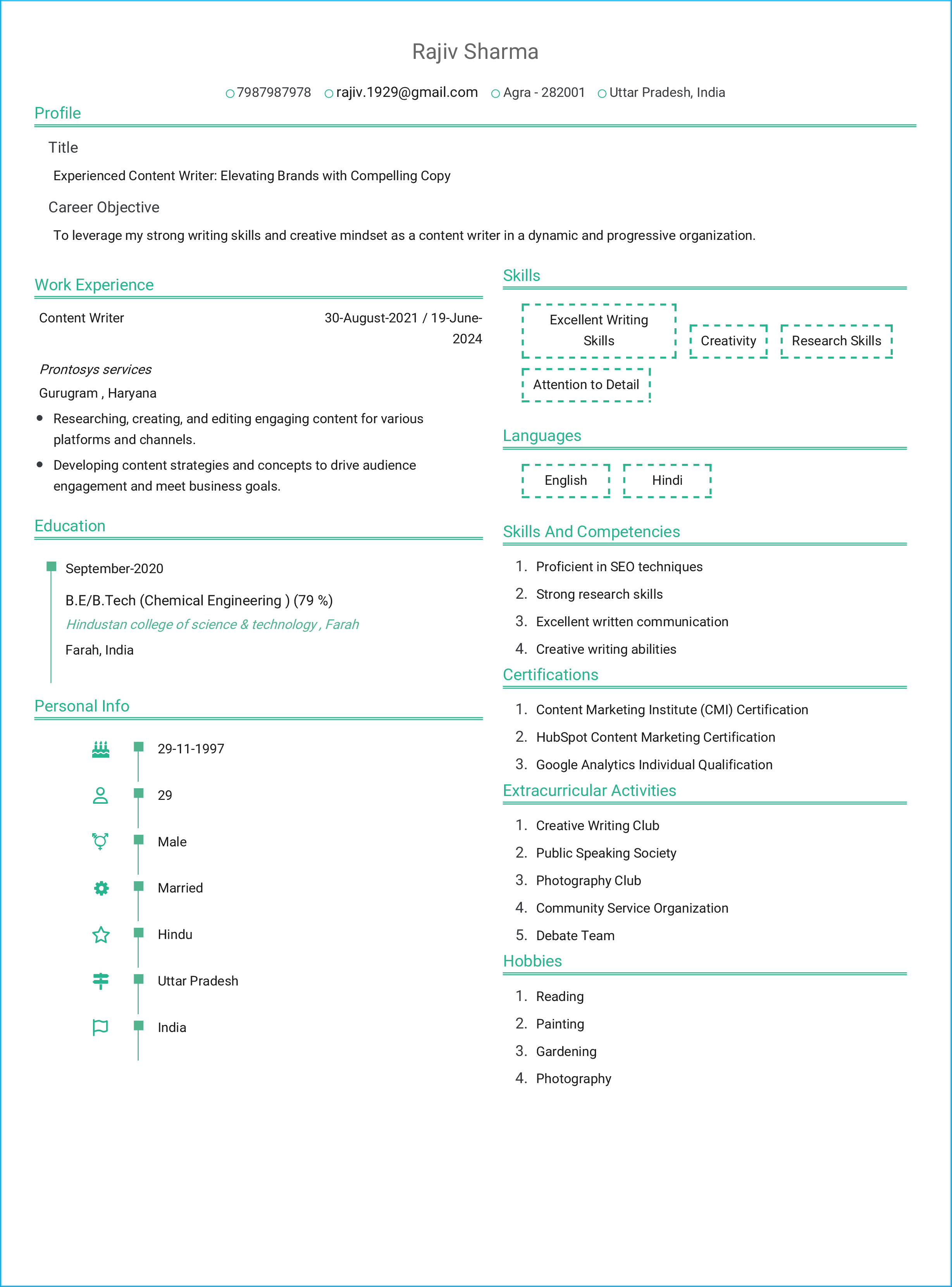
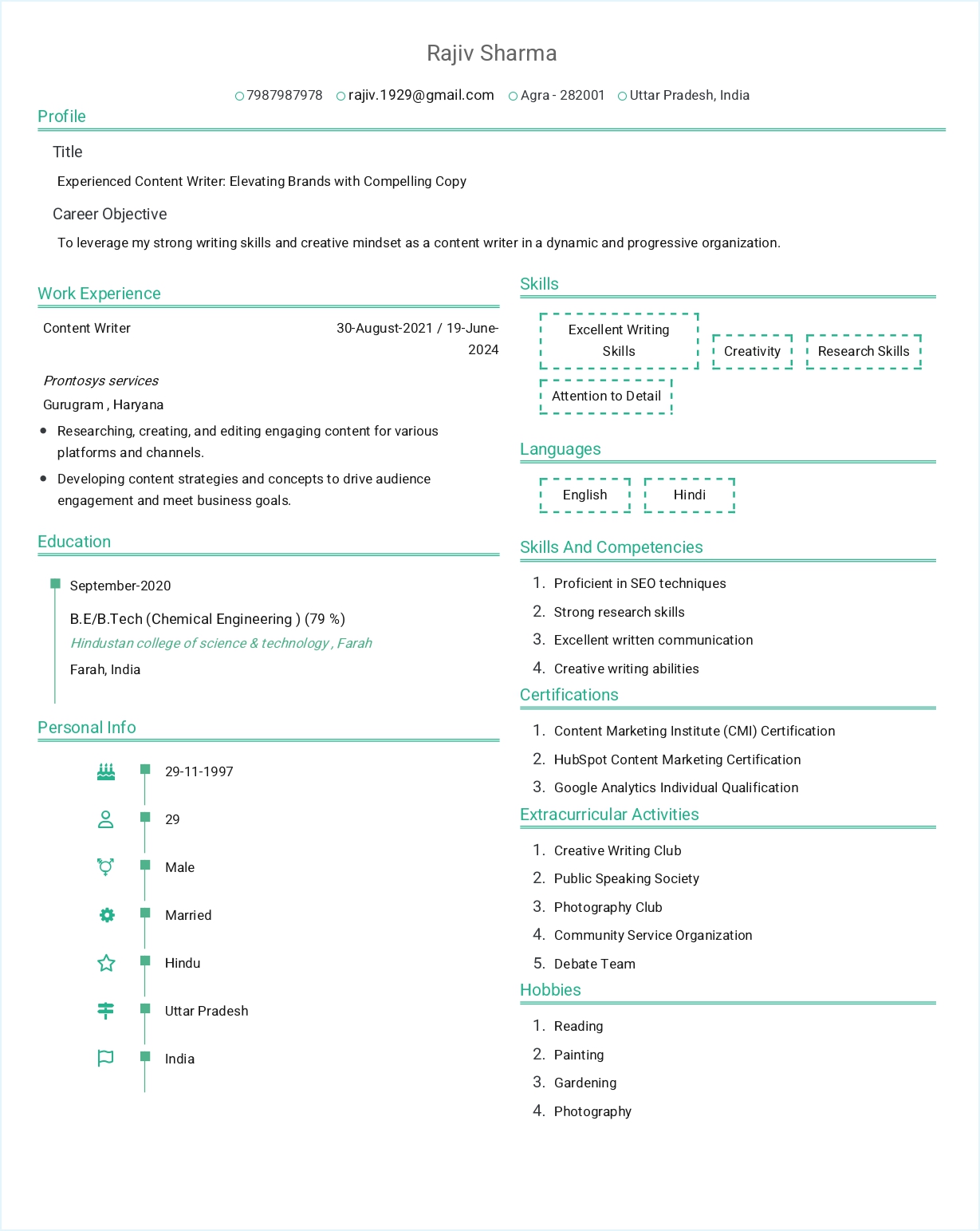
While a writer has the ability to craft resumes in various innovative formats, adhering to a structured approach can prove advantageous. It is advisable to establish distinct sections for each critical component of the resume, such as the summary, key skills, work experience, and qualifications. Emphasizing or bolding the most compelling aspects of your profile that align with the job description you are targeting is recommended. To compose a resume for a content writer, please follow these steps:
1. Choose the best resume format for experienced
Before you begin to complete the content, let us discuss the proper way to format your writer's resume. In essence, there are three resume formats available for selection: Functional, Reverse-chronological, and Combination. Nevertheless, the most advisable choice is to opt for the reverse-chronological format for your writer's resume. In general terms, the reverse-chronological resume format is considered the most reliable option. This is due to its ability to prominently showcase your work experience by presenting your most recent positions first, and it is also the preferred format among recruiters.
Key components of an effective resume layout:
- Adjust the margins: This ensures that resume of content writer resume appears organized and free from clutter.
- Select a professional font style: It is essential for your writer's resume to be easily readable, so opt for a straightforward and professional font that presents well in both PDF and printed formats.
- Utilize an appropriate font size: A font that is too small may be difficult to read, while one that is excessively large could extend your resume onto a second page.
- Incorporate bullet points: Bullet points not only enhance the neatness of your writer's resume but also facilitate quick skimming by the hiring manager.
- Maintain brevity: Keeping your resume concise increases the likelihood that the hiring manager will read it, especially since they review numerous resumes daily.
- Select the correct file format: This guarantees that your resume retains its formatting regardless of the device or operating system used by the hiring manager to view it.
Utilize a resume template to save time
As a writer, your primary goal is likely to begin crafting your resume promptly. However, if you are creating your writer's resume from the ground up, you must first address the formatting. Best resume templates for experienced professionals can assist you in saving time while also making a strong impression on the hiring manager. Developed in partnership with experienced hiring managers, these templates are easy to read, well-organized, contemporary, and visually attractive.
2. List down your contact details
After selecting the appropriate format for your writer resume, you can concentrate on completing the content. To begin, let’s cover the essentials - start by noting your contact details, which should include: Your first name and last name.
- Your professional title (optional)
- Your phone number
- Your email address
- Your location (city and state)
- Your writing website/portfolio/relevant social media profiles, blog, etc.
It doesn’t get any simpler than this, does it? Just ensure that you avoid any errors (this is crucial for your entire writer resume) - ultimately, no organization wishes to employ a writer who cannot spell correctly and lacks attention to detail.
3. Write an impactful and good professional summary on resume
Every writer understands the significance of engaging the audience from the very first few sentences. Similarly, crafting a resume is no exception - in fact, creating a good resume profile summary presents an opportunity to capture the hiring manager’s interest. Essentially, the purpose of a resume summary is to provide the hiring manager with a concise yet impactful overview of your professional experience. Consequently, in merely 2-3 sentences, your resume summary indicates to the recruiter whether you are a suitable candidate and assists them in determining if they should examine your writer resume more closely. Therefore, here are the components you should include in your resume summary to impress the hiring manager:
- Your professional title and years of experience
- Your most pertinent writing skills
- Your top 1-2 professional accomplishments
4. Write a good work experience
After crafting an engaging resume summary, you are prepared to develop the most crucial section of your writer's resume - your work experience. First, let us discuss the formatting - here is the procedure:
- Adhere to the reverse-chronological order. To maintain uniformity throughout your writer's resume, start with your most recent work experience and proceed backward.
- Specify the job title. Ensure that it accurately reflects your previous role and refrain from using jargon. The term ‘Copywriter’ is significantly more professional than ‘Keyboard Wizard.’
- Provide company information. Only include essential details about the company, such as its name and location. You may also add a brief description of the company, particularly if it is not widely recognized.
- Indicate the employment duration. Consistently use the mm/yyyy format throughout your writer resume. Document your responsibilities and accomplishments. Utilize 5-6 bullet points for recent positions and 2-3 for earlier roles.
What should you do if you lack work experience?
While the work experience section is undoubtedly the most crucial aspect of your writer's resume, it does not imply that you cannot create a job-winning resume for content writer fresher with no experience. As an individual who has a passion for writing, you probably possess various forms of writing experience, even if you have not yet held a formal position as a writer. Therefore, rather than concentrating solely on work experience, you can highlight any other writing-related experiences you may have, such as:
- Academic projects.
- Volunteering.
- Internships.
- Extracurricular activities.
- Personal projects.
For instance, if you operate a blog, be sure to include it on your beginner content writer resume, particularly if it boasts a significant following.
5. Provide a brief overview of your educational background
It is important to be candid—hiring managers prioritize your writing abilities and professional experience over your academic qualifications. Therefore, it is advisable to include only essential educational information in your resume as a writer. Begin with your most recent degree and present your educational details in the following manner:
“Degree Name
University, college, or other educational institution
Location (optional)
Years attended”
6. Add the most demanding skills in your content writer resume
In addition to work experience, the skills section is a crucial part of your writer's resume that demonstrates your capabilities to the hiring manager. Therefore, it is essential to optimize this section—this does not imply listing every skill you possess on your writer resume. Below are additional tips to help you maximize the effectiveness of your skills section:
- Incorporate any relevant skills that the company seeks. To demonstrate that you are an excellent candidate for the role, ensure that you thoroughly review the job description. If any skills mentioned align with your qualifications, be sure to include them in your writer's resume.
- Investigate the most sought-after writing skills. If you find it challenging to determine which skills to feature, take the time to research the skills that are currently in high demand within the industry. Alternatively, you may refer to our compilation of 101+ essential skills for additional ideas.
- Distinguish between your hard and soft skills. By dividing your skills section into two categories, you facilitate easier navigation and enhance the organization of your writer's resume.
7. Include the optional resume sections
Is there still available space on your writer's resume? Utilize it to highlight your distinctive professional experiences through one or more of the following optional resume sections:
- Languages: Be sure to indicate any language skills on your writer's resume, particularly if it implies that you write in several languages.
- Publications: Should you have published studies, interviews, research papers, or similar works, be sure to include them in your writer's resume.
- Associations and organizations: List your memberships in writers’ associations and organizations, along with your roles within them.
- Conferences: Mention any writing or industry-related conferences on your writer's resume to demonstrate your engagement in the field.
- Awards: If your writing has garnered recognition and awards, do not hesitate to include this information on your writer's resume.
8. Include a portfolio link in your resume
Incorporating a link to a professional portfolio can enhance the resumes of content writers. While the resume holds significance, it is ultimately your writing skills and previous projects that will determine a company's hiring decision. This strategy offers hiring managers immediate access to your finest writing samples, thereby improving your likelihood of securing an interview.
Conclusion
In this blog, we have discussed all the essential elements required to craft a compelling content writer resume that distinguishes itself. By emphasizing crucial skills, organizing work experience, and incorporating additional sections, each aspect contributes to enhancing the effectiveness of your resume. A well-organized resume significantly boosts your likelihood of attracting the attention of recruiters and obtaining interviews.
FAQ’s
Q. What should I include in my freelance writer resume sample in terms of work experience?
A. Absolutely, freelance writing experience is significant and ought to be included. Present it similarly to a standard job by detailing the clients you collaborated with, the nature of the content you produced, and any quantifiable results. This demonstrates adaptability, self-motivation, and the capability to handle multiple projects.
Q. How do I tailor my resume for different content writing roles?
A. Carefully examine the job description and adjust your resume by aligning your skills, keywords, and experiences with the position. If a job highlights SEO writing, emphasize your SEO knowledge. Conversely, if it pertains to technical writing, illustrate your research abilities and clarity in communication.
Q. How long should a content writer’s resume be?
A. Ideally, a content writer’s resume should be one page, particularly if you possess less than 10 years of experience. For those with extensive experience, a two-page resume is permissible. Maintain conciseness, concentrating on key accomplishments and pertinent skills.
Q. Can you include non-writing jobs in my content writer resume?
A. Yes, non-writing positions can be included if they encompass skills pertinent to communication, research, or marketing. Emphasize transferable skills such as audience analysis, social media management, project coordination, or research proficiency. Ensure to link your past work experiences to your writing capabilities, illustrating how those roles have improved your ability to produce engaging and thoroughly researched content.
Q. How can I create an effective content writer resume?
A. To craft an effective content writer resume, concentrate on highlighting your writing abilities, SEO knowledge, and measurable accomplishments. Utilize a clean, professional layout with sections such as Profile Summary, Work Experience, Core Skills, and Education. Accentuate your capacity to generate engaging, SEO-optimized content and incorporate metrics to quantify your successes. Additionally, make sure to customize your resume for each position by aligning it with the job description.