

Table of Contents
▼- Data Scientist Resume Example & Writing Guide
- Must have elements of a resume
- Pop your data scientist resume with action words.
- Customize your resume according to the job description.
- Conclusion
- FAQ’s related to a Data Scientist Resume
- Q. How long should I make my Data Scientist resume?
- Q. What is the best way to format an experienced data scientist resume?
- Q. What should I avoid when writing my Data Scientist resume to ensure its professional and impactful?
- Q. How to write a data scientist resume with no experience?
Data Scientist Resume Example & Writing Guide
The need for data scientists is projected to increase by 37% between 2023 and 2033, resulting in intense competition within this sector. Therefore, creating a data science resume that distinguishes itself in 2025 necessitates more than merely enumerating technical abilities—it involves tailoring your resume to the job description and enhancing it for Applicant Tracking Systems (ATS).
In this article, we will explore several crucial tips and strategies for developing a persuasive, professional, and easily readable best data scientist resume that will capture the interest of any hiring manager or recruiter.
Must have elements of a resume
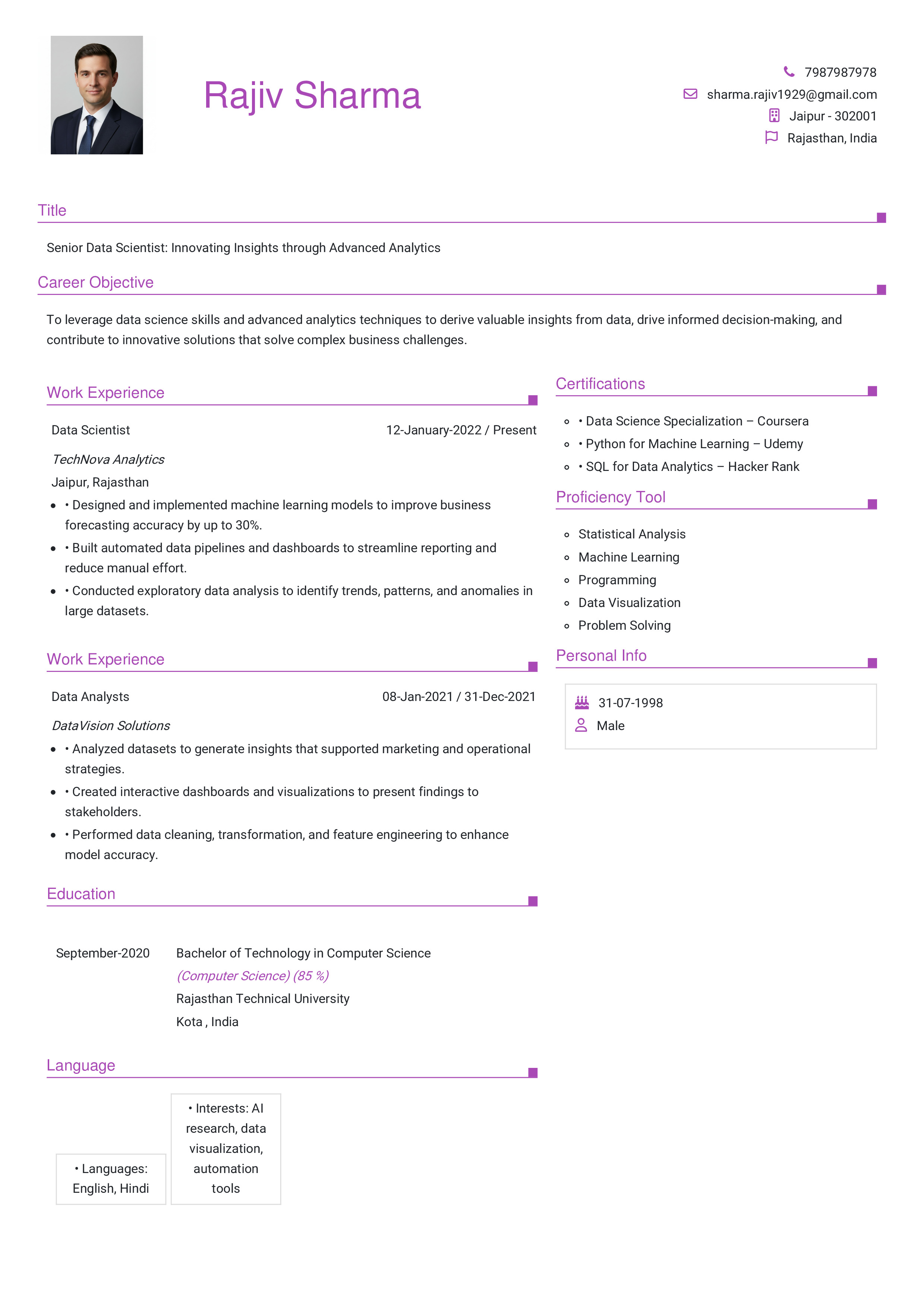
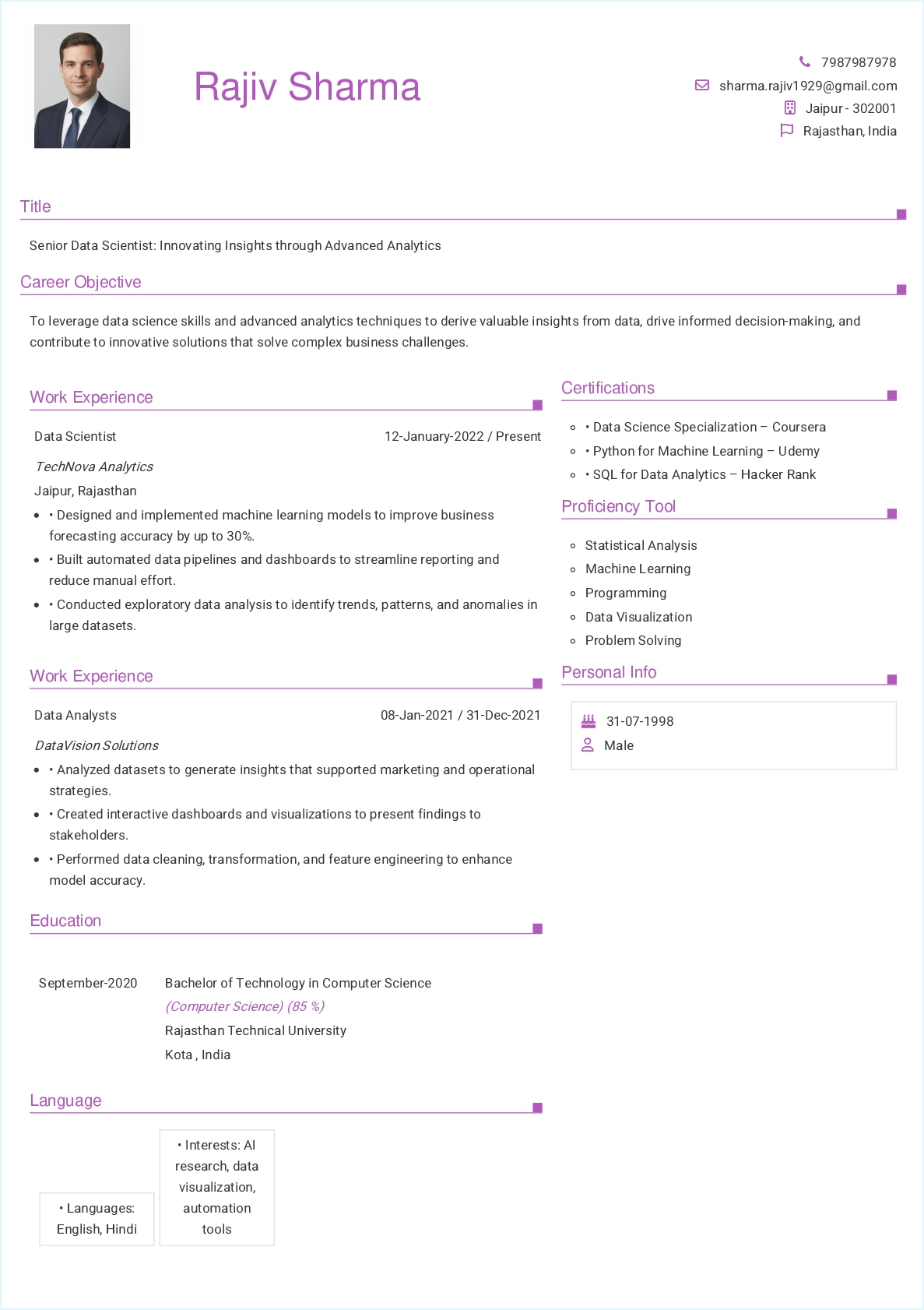
Essential components of an effectively crafted data scientist resume encompass work experience, contact details, pertinent skills, and educational qualifications. Additionally, you may incorporate achievements, accolades, or professional interests as space permits. Structure your resume to emphasize these fundamental elements. When selecting a format, it is advisable to utilize reverse chronological order. This approach will highlight your latest work history and educational background to prospective employers. Such information is typically the most significant, and a reverse chronological format facilitates easy access to these details.
1. Include your work experience.
Your work experience should be the first element an employer encounters following your contact details and a brief objective or summary. It is advisable to prioritize experience, as it holds significant importance in the data science field. When detailing your experiences, present them in chronological order, starting with your current or most recent position and moving backward. Include only relevant experiences. For each role you have occupied, arrange the following essential information in this sequence:
- Title of your position
- Name of the company
- City and state
- Your starting and ending dates
- A bulleted list of your most significant achievements and key responsibilities
If you are a recent graduate without any experience, focus on building that experience before drafting your resume. Some suggestions to craft an entry-level data scientist resume:
- Freelancing in a relevant position or organisation
- Contributing to open-source projects, such as GitHub, to enhance your portfolio.
- Developing mock projects that you can link to demonstrate your skills.
2. List your education.
Include your educational background on your resume, starting with the highest degree obtained. Position the education section after the experience section, as experience is prioritized. If you are a recent graduate or have limited experience in data science, you may opt to list your education first.
Structure your educational history in the following order:
- Degree type, major
- Name of your school
- Years studied
- Any relevant honours received
- Relevant coursework
3. Outline your skills.
Following the enumeration of your professional experience and educational background, it is essential to highlight your skills required for data scientist. Present these skills in a bulleted format to enhance readability, and incorporate action verbs whenever possible. For instance, "skilled in JavaScript."
Begin with your technical competencies, prioritizing those that you consider your most robust data science skills relevant to the job you are seeking. It is important to include both technical and interpersonal skills. While it is not mandatory to differentiate between the two, ensure that you acknowledge both categories of skills.
Hard skills needed for data scientist resume:
- Quantitative Analysis
- Data Visualization
- Data Analysis
- Machine Learning
- Modelling
- Debugging
- Programming
- Statistics
Soft skills required for data scientist resume:
- Critical Thinking
- Time-Management
- Communication
- Research
- Collaboration
4. List your certifications.
Enumerate any data scientist certifications you possess that are vital to the position you are applying for, placing them above your experience section. This will effectively emphasize these critical skills in a manner that the hiring manager can readily observe.
In your position, you are likely to acquire certifications in various programming languages, including Python, SQL, MySQL, and Git. Additionally, you may pursue certifications that are specifically relevant to the data scientist profession, such as SAS Certified Data Scientist or Microsoft Certified: Azure Data Scientist Associate.
Proceed to list other certifications you hold below the most significant ones. This should encompass certifications that may not be directly related to the job but demonstrate that you possess additional skills that could be advantageous to the role.
Include a header that shows "Certifications" and lists the following information about your credentials:
- Complete title of certification and acronym
- Company name from which you received the certification
- Date of receiving the certification
5. Data scientist resume summary
You might have encountered the terms summary and objective being used interchangeably in discussions regarding resumes. To clarify, a summary generally encapsulates your industry experience along with a few notable career achievements in 2-3 sentences. In contrast, an objective outlines your future aspirations.
An effective approach for crafting a professional summary in resume for data scientist is to compose 2-3 sentences that address the following aspects:
- Your professional title and role within the industry
- A significant career achievement
- A common goal shared between you and your prospective employer
Pop your data scientist resume with action words.
To distinguish your resume from others in the competitive landscape, it is advisable to incorporate strong action words in resume that highlight your accomplishments:
- Conceptualized
- Determined
- Formulated
- Initiated
- Managed
- Spearheaded
Customize your resume according to the job description.
A generic resume will not suffice in the current competitive job landscape. To enhance your likelihood of securing an interview, it is essential to tailor your resume for each job application by aligning your skills, experiences, and keywords with the specific job description.
Consider the following tips to effectively customize your resume to the job description:
- Examine the job description: Determine the key skills, tools, and qualifications that the employer seeks.
- Include pertinent keywords: Utilize industry-specific terminology and technologies referenced in the job posting to navigate Applicant Tracking Systems (ATS).
- Align your experience with job criteria: Emphasize previous projects and accomplishments that are directly relevant to the position.
- Highlight relevant skills: If the position focuses on deep learning or cloud computing, make sure those skills are prominently featured in your resume.
Conclusion
An effectively optimized resume serves as your gateway to distinguishing yourself in the highly competitive data scientist job market of 2025. By demonstrating your technical skills, emphasizing quantifiable accomplishments, and customizing your application for each position, you can greatly enhance your likelihood of securing interviews. Keep in mind that ATS-friendly format for resume, thoughtful keyword integration, and an engaging professional summary can be pivotal.
FAQ’s related to a Data Scientist Resume
Q. How long should I make my Data Scientist resume?
A. According to a 2024 LinkedIn analysis of successful Data Scientist hires, an optimal length for this role is 1-2 pages. A notable 84% of Data Scientists who obtained interviews had resumes that were under two pages long.
Q. What is the best way to format an experienced data scientist resume?
A. The chronological-hybrid format is the most effective for Data Scientist resumes, as 76% of hiring managers favor this structure. This format effectively highlights both your career progression and technical skill set.
Q. What should I avoid when writing my Data Scientist resume to ensure its professional and impactful?
A. To make your Data Science Resume stand out, refrain from using generic terms or ambiguous language. Concentrate on specific achievements, incorporating numbers and data that illustrate your real-world impact.
Q. How to write a data scientist resume with no experience?
A. Emphasize projects, coursework, internships, Kaggle competitions, and relevant skills such as Python, machine learning, and data analysis. Craft a compelling summary and underscore transferable skills from previous roles.