




Table of Contents
▼- How to Write a Nursing Resume: Examples & Writing Guide
- Why Your Nursing Resume Matters
- How to Format and Layout Your Resume
- What to Include in a Nursing Resume
- How to Write Each Section in Resume
- Professional Summary / Objective
- Skills Section
- Certifications & Licences
- Work Experience
- Education
- Optional Sections
- Best Resume Tips for Nurses
- Example Resume
- Common Resume Mistakes to Avoid
- Final Checklist for Resume
- Conclusion
- FAQ
- 1. What format is best for a nursing resume?
- 2. Do I need to include references?
- 3. Should I list all my clinical rotations as a new nurse?
- 4. What are the most important skills to include?
How to Write a Nursing Resume: Examples & Writing Guide
If you’re starting or growing your nursing career in 2025, your resume is your first step to success. Think of it as your personal story a way to show hospitals and clinics who you are, what you can do, and how you care for patients. A good nursing resume doesn’t need fancy words or complicated design. It just needs to be clear, simple, and focused on your strengths. In this guide, we’ll walk you through every step to create a professional nursing resume that truly stands out.
Why Your Nursing Resume Matters
Your resume is usually the first thing employers see, so it needs to leave a strong impression. A well-written nursing resume helps hiring managers quickly understand your skills, experience, and certifications. It also shows that you’re professional and serious about patient care.
How to Format and Layout Your Resume
The format decides how your information appears on the page. Choose one that fits your background best.
|
Format |
When to Use It |
Best For |
|
Reverse-Chronological |
You have steady work experience |
Most common and preferred by employers |
|
Functional (Skills-Based) |
You’re new or changing careers |
Focuses on skills rather than jobs |
|
Combination / Hybrid |
You have both strong skills and experience |
Mixes both formats effectively |
Most nurses should use the reverse-chronological format because it highlights your work history clearly.
What to Include in a Nursing Resume
A professional nursing resume should include these key sections:
- Header: Name, title (e.g., Registered Nurse), contact details (phone, email, LinkedIn).
- Professional Summary or Objective: A short 2–4 sentence introduction.
- Skills Section: List your top nursing and technical skills.
- Certifications & Licences: RN, BLS, ACLS, etc.
- Experience: Your past jobs, responsibilities, and achievements.
- Education: Nursing degree(s) and school information.
- Optional Sections: Volunteer work, languages, memberships, or awards.
How to Write Each Section in Resume
Here are detailed explanations on how to write each section of a resume.
Professional Summary / Objective
This short paragraph gives employers a quick idea of who you are.
Example (for new nurse): Caring and motivated nursing graduate with clinical experience in surgical care. Skilled in patient communication, teamwork, and EHR documentation. Excited to support quality patient care at XYZ Hospital.
Example (for experienced nurse): Registered Nurse with 5+ years of hospital experience. Strong background in post-operative care, patient safety, and wound management. Known for improving patient satisfaction and reducing readmission rates.
Skills Section
Choose skills that fit the job you’re applying for:
- Patient assessment and monitoring
- IV therapy and wound care
- Electronic Health Records (EHR) documentation
- Medication administration
- Teamwork and communication
- Emergency response
- Patient and family education
Certifications & Licences
Make sure to include valid and current credentials.
Example:
- Registered Nurse (RN)- State of California, Licence #123456- 2022
- Basic Life Support (BLS)- American Heart Association- 2024
- Advanced Cardiovascular Life Support (ACLS)- 2023
Work Experience
List your jobs in reverse order (most recent first).
Format Example:
Job Title, Employer – City, State | Dates
- Action verb + what you did + result.
Example:
Registered Nurse – ABC Hospital, New York | 2021–Present
- Delivered care for 25+ patients per shift in a 40-bed surgical unit.
- Trained junior nurses and improved patient satisfaction to 95%.
- Helped reduce patient readmission by 10% through education programs.
Use action words like managed, delivered, assisted, improved, and add numbers when possible to show results.
Education
List your most recent or highest degree.
Example:
Bachelor of Science in Nursing (BSN)
University of Health Sciences - Graduated May 2020
You can also include honors, special projects, or continuing education courses.
Optional Sections
These can help your resume stand out:
- Volunteer Work: Free medical camps, community clinics, health awareness programs.
- Professional Memberships: Nursing councils or associations.
- Languages: Especially if you speak more than one helpful in diverse workplaces.
- Awards: Any recognition or hospital achievement.
Best Resume Tips for Nurses
- Use keywords: Many hospitals use digital systems to scan resumes. Include terms from the job posting (e.g., “acute care,” “critical care,” “telemetry”).
- Show results: Include numbers or examples of how you improved patient care or teamwork.
- Keep it modern: Highlight current nursing technologies like telehealth or EHR software.
- Keep it short: 1–2 pages maximum, clear and easy to read.
- Save as PDF: It keeps your formatting neat.
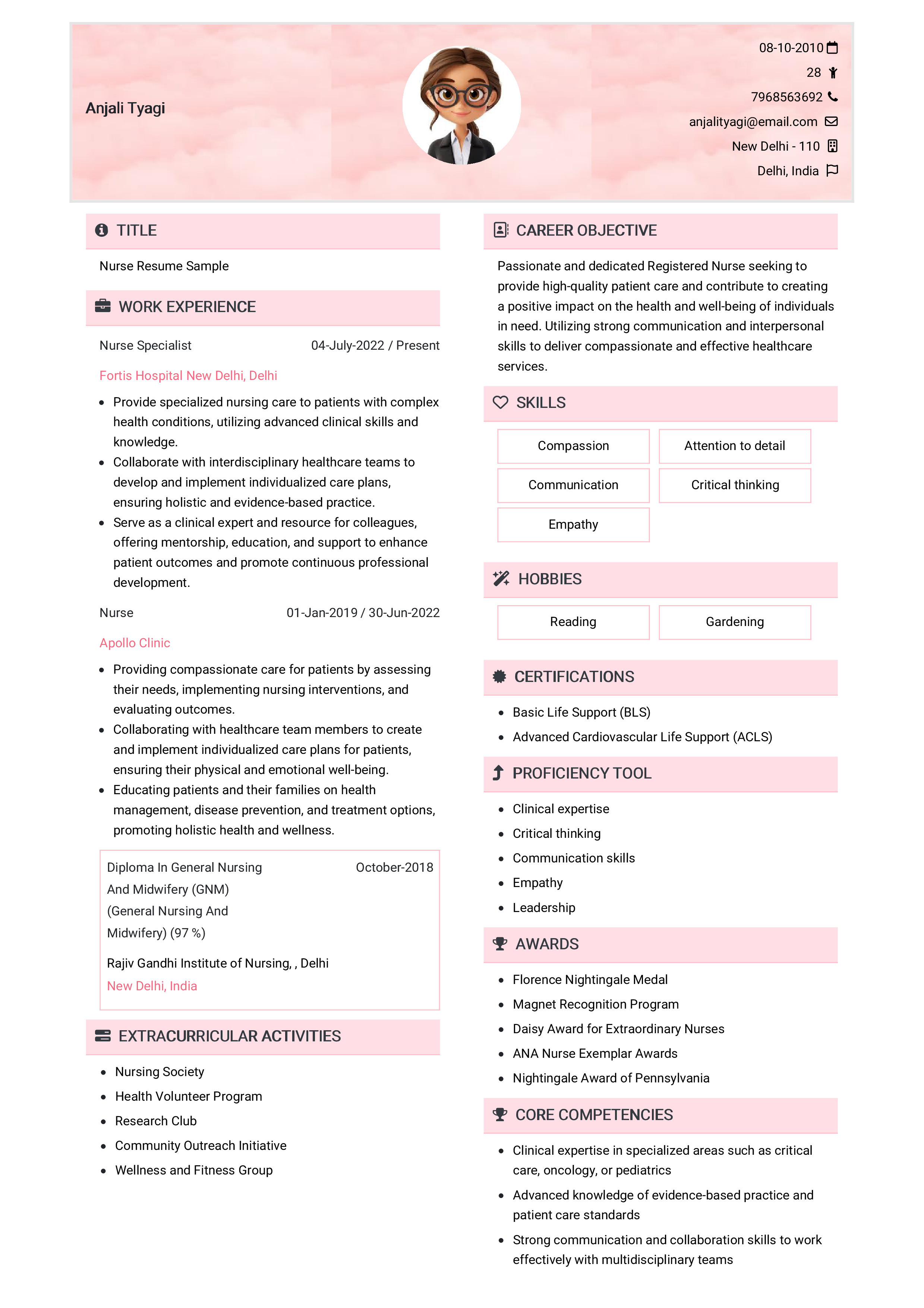
Example Resume
Name: Sarah Johnson, RN
Phone: (555) 123-4567 | Email: sarah.johnson@email.com | Location: Chicago, IL
Professional Summary
Caring Registered Nurse with 4 years of experience in hospital settings. Skilled in patient assessment, wound care, and EHR documentation. Committed to providing safe and compassionate care to all patients.
Key Skills
- Patient assessment & monitoring
- Wound management
- Medication administration
- EHR documentation
- Team collaboration
- Patient education
Certifications
- Registered Nurse (RN) – Illinois – 2022
- BLS & ACLS Certified – 2023
Experience
Registered Nurse – ABC Medical Center | 2021–Present
- Provided care for 30+ patients per shift in a surgical unit.
- Reduced patient discharge delays by 15% through improved coordination.
- Educated patients on post-operative care to increase satisfaction.
Education
Bachelor of Science in Nursing – University of Illinois, 2020
Languages: English, Spanish
Common Resume Mistakes to Avoid
- Typos or grammar mistakes.
- Listing duties instead of achievements.
- Using fancy designs that are hard to read.
- Forgetting to update certifications or contact info.
- Sending the same resume to every job (always tailor it!).
Final Checklist for Resume
- Clear and easy to read
- Includes job-specific keywords
- Highlights achievements and numbers
- Shows up-to-date licences
- Proofread for errors
- Saved as PDF
Conclusion
Your nursing resume is your chance to show your care, skills, and professionalism. Keep it simple, honest, and focused on how you help patients and teams succeed. With the right format and clear details, your resume will stand out and help you land your next nursing role in 2025.
FAQ
1. What format is best for a nursing resume?
The reverse-chronological format is the most common and preferred. It shows your most recent job first and helps employers quickly see your career growth.
2. Do I need to include references?
No, it’s not necessary to list references directly on your resume. You can simply write References available upon request.
3. Should I list all my clinical rotations as a new nurse?
If you’re a new graduate, yes include your most relevant clinical rotations with the unit name, hospital, and skills you practiced. Once you gain work experience, you can remove them.
4. What are the most important skills to include?
Include both technical and soft skills:
- Technical: IV therapy, wound care, EHR documentation, medication administration
- Soft: Communication, teamwork, empathy, patient education