


Table of Contents
▼- Data Analyst Resume Examples and Writing Guide for 2025
- What Employers Want to See on a Resume
- How to Format and Layout Your Resume
- Header & Professional Summary with Example
- Skills Section: Skills Employers Want to See on a Resume
- Work Experience Section
- Education & Certifications Section
- Projects and Extra Work Section
- Heading Tips for a Strong Resume
- How to Structure Your Resume
- Common Mistakes to Avoid in a Resume
- Final Checklist for Resume
- Conclusion
- FAQ
Data Analyst Resume Examples and Writing Guide for 2025
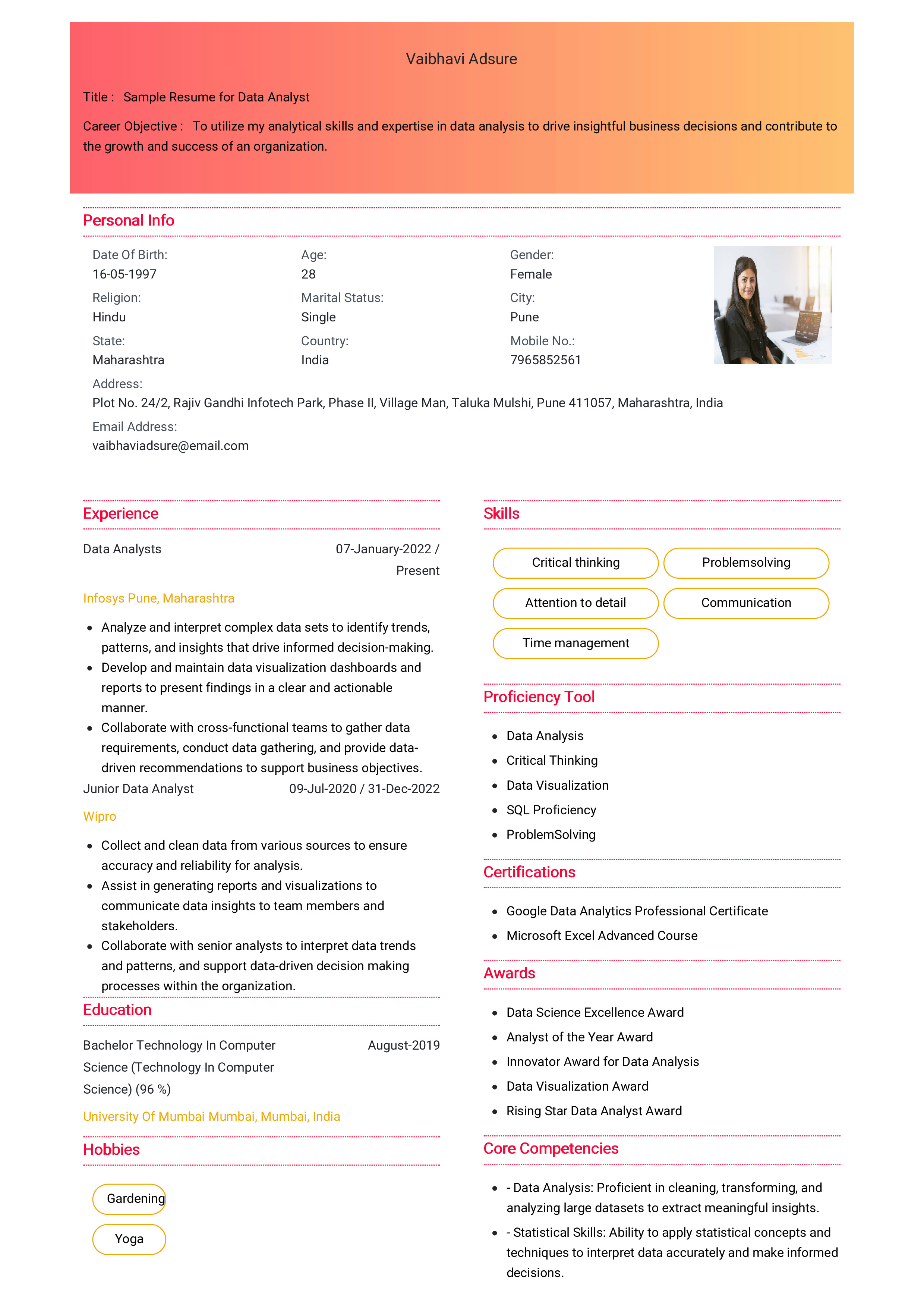
If you want to become a data analyst in 2025, having a strong resume is your first step. A resume is not just a list of your jobs or skills it’s your chance to show employers how you can solve problems with data, make smart decisions, and help the business grow. In this guide, we will explain how to create a Data Analyst Resume step by step, a clear, simple, and powerful resume that gets noticed. We will also give examples, bullet points, and a table to make it easy to follow.
What Employers Want to See on a Resume
When hiring a data analyst, employers usually look for these things:
- You understand the business, not just the tools.
- You know technical skills like SQL, Python, R, Tableau, or Power BI.
- You show results with numbers, like improving sales or saving time.
- Your resume is clear, simple, and easy to read.
In short, they want someone who can use data to make decisions and add value.
How to Format and Layout Your Resume
A good resume layout helps both hiring managers and applicant systems read your resume. A clear resume gets noticed faster.
Resume Format Layout Tips:
- Use a simple, clean format (reverse-chronological is most common).
- Keep it one page if possible.
- Save it as PDF to keep formatting.
- Avoid fancy graphics or colors that may confuse ATS.
Recommended Section for Your Resume:
- Header (name, contact info, LinkedIn/GitHub/portfolio)
- Professional summary
- Skills (technical + soft skills)
- Work experience (with bullets)
- Education & certifications
- Projects / extra information
Header & Professional Summary with Example
Header: Make sure your name, phone, email, and online profiles (LinkedIn, GitHub) are easy to find.
Professional Summary: A short 2-3 sentence description of your skills and achievements.
Example: Data Analyst with 3 years of experience using SQL and Python to build dashboards and models. Improved customer loyalty by 15% through data analysis. Skilled in turning complex data into actionable insights.
Skills Section: Skills Employers Want to See on a Resume
Your skills section should include both technical skills and soft skills. This helps employers quickly see what you can do.
Example Skills:
- Technical: SQL, Python, R, Excel (advanced), Tableau, Power BI, ETL
- Soft/Business: Data storytelling, communication, problem-solving, teamwork
Use the same skills listed in the job posting to get past applicant tracking systems
Work Experience Section
This section is the most important part of your resume. Focus on your achievements and the results you delivered
How to Structure It:
- Company, location, role, dates
- 3-6 bullet points showing your impact (use numbers if possible)
Example Work Highlights:
- Made a Power BI dashboard to track KPIs for 10 teams, saving 20 hours per week.
- Worked with marketing teams to improve campaign conversion by 18%.
- Created charts and graphs to help teams make better decisions.
Use Action Verb + Task + Result for each bullet.
Education & Certifications Section
List your degree, school, and graduation year. Then add any relevant certifications or professional courses you have completed.
- Google Data Analytics
- Tableau Specialist
- Microsoft Power BI
If you’re a recent graduate, include important courses or projects.
Projects and Extra Work Section
If you have less experience, showcase projects. Include tools and results.
Example Project: Sales Forecast Dashboard (Python, Tableau). Made a dashboard to predict weekly sales for 50+ stores. Accuracy went up from 70% to 85% in three months.
Other extra sections: volunteer work, languages, or publications if relevant.
Heading Tips for a Strong Resume
- Show data storytelling: explain insights, not just numbers.
- Highlight modern tools: Python, R, Power BI, Snowflake.
- Use specific results: improved process by 20% or predicted X with 90% accuracy.
- Show adaptability: cloud tools, real-time data, or industry knowledge.
- Include domain expertise if relevant (finance, healthcare, marketing).
How to Structure Your Resume
Here is a simple structure that works well:
|
Section |
What to include |
Why it matters |
|
Header |
Name, contact info, LinkedIn/GitHub |
Easy to reach & show your presence |
|
Professional Summary |
2–3 sentence snapshot of value |
Shows quickly why you are fit |
|
Skills |
Technical + soft skills |
ATS and employers, look here |
|
Work Experience |
Role, company, bullets with metrics |
Shows your achievements |
|
Education & Certs |
Degree, school, certifications |
Validates your knowledge |
|
Projects / Extras |
Side projects, tools used, results |
Helps if less experience |
Common Mistakes to Avoid in a Resume
- Too general: Show what you achieved, not just what you did.
- Overly fancy design: Keep it simple for easy reading.
- Missing keywords: Match your resume to the job description.
- Typos or errors: Check carefully; mistakes look unprofessional.
- Irrelevant info: Only include skills and experiences that matter.
Final Checklist for Resume
Before sending your resume, make sure:
- Customized to the job description
- Each bullet shows impact with numbers
- Skills match tools & business context
- Clean layout
- Saved as PDF
- Proofread for grammar/spelling
- Linked to portfolio/GitHub if available
Conclusion
A strong data analyst resume in 2025 focuses on results, tools, and problem-solving skills. Keep it simple, clear, and customized to each job. Show employers that you can turn data into action. Follow this guide, and your resume will stand out to both humans and computer systems.
Ready to create your resume? Check the jobscruze platform to build a professional data analyst resume today!
FAQ
1. How long should my data analyst resume be?
Your resume should ideally be one page if you have limited experience. If you have several years of work experience, it can be two pages, but make sure every detail is relevant and easy to read.
2. What are the key elements of a data analyst resume?
A strong data analyst resume includes:
- Contact information
- Professional summary or objective
- Key skills (technical and soft skills)
- Work experience with measurable achievements
- Education and relevant certifications
- Optional sections like projects, awards, or volunteer work
3. Why is it important to customize my resume for each application?
Customizing your resume helps you match the job requirements. Employers use keywords from the job posting, so tailoring your resume increases your chances of passing Applicant Tracking Systems (ATS) and catching the hiring manager’s attention.
4. What is the best format for a data analyst's resume?
Use a clean, professional format with reverse chronological order for work experience. Keep fonts simple and sections easy to scan.