





Table of Contents
▼- Tax Consultant Resume Examples & Writing Guide
- What is the role of a Tax Consultant?
- Here are the steps to follow for your tax consultant resume:
- 1. Choose the right format
- 2. Mention your work experience:
- 3. Showcase your taxation skills in resume
- 4. Describe your educational background
- 5. Adding summary/objective
- Tailor your resume to the job description.
- Keep in mind these common mistakes to avoid.
- Key takeaways
Tax Consultant Resume Examples & Writing Guide
As a tax consultant, it can be difficult to express your intricate experience with tax laws and basic accounting principles clearly and succinctly on a resume. Our guide offers strategic advice and examples, ensuring that you effectively showcase your expertise to prospective employers.
What is the role of a Tax Consultant?
A Tax Consultant is a specialist in taxation who offers guidance to individuals and businesses regarding their tax responsibilities and the most effective ways to fulfill them. Talking about tax consultant job responsibilities, they assist clients in comprehending their tax obligations and identifying any deductions or credits that may alleviate their total tax liability.
Here are the steps to follow for your tax consultant resume:
1. Choose the right format
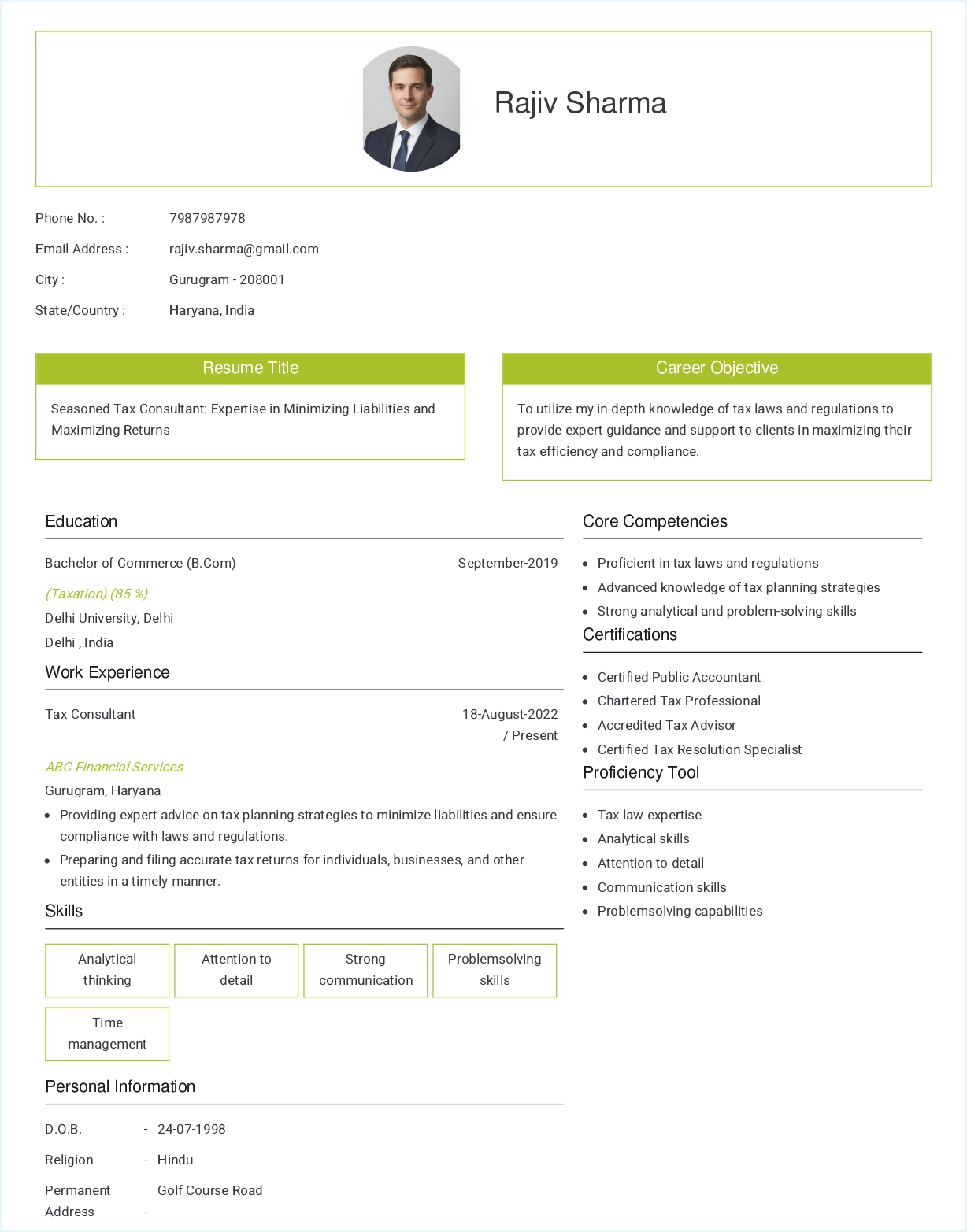
The reverse-chronological resume format is particularly suitable for individuals with significant relevant professional experience to highlight. This format adheres to a straightforward logic and emphasizes your experience. Maintain a simple header that includes your contact information, a headline specifying the position you are applying for or your current job title, and a link to your portfolio. Make sure your resume for a tax consultant job role does not exceed two pages, unless you are applying for a more senior position or possess over ten years of relevant experience. Save your tax accountant resume in PDF format to preserve its layout and presentation.
2. Mention your work experience:
Incorporate your expertise that corresponds with the job requirements. Always make sure to substantiate your achievements by detailing a skill, the actions you took, and the outcomes that resulted from your responsibilities. When composing each experience bullet, ensure that you employ active language. If you can mention a personal skill that you have developed as a result of your experience, this would enhance your uniqueness. Be precise regarding your work experience of tax consultant in resume - it is insufficient to state that you can "communicate"; instead, what is your history of communication?
Entry level tax consultant resume without experience
Rather than presenting your experience in a reverse-chronological order (beginning with the most recent), you should go for a functional-skill-based format. This approach allows tax accountant resumes to concentrate more on strengths and skills.
3. Showcase your taxation skills in resume
Are you curious about the ideal tax accountant resume? The profile of the candidate aligns with job specifications by effectively integrating both hard and soft skills throughout their resume. When detailing your distinct tax advisory skills set, it is essential to reference the job advertisement to identify the key requirements. This practice guarantees that your tax advisor resume is customized to closely align with the characteristics of the ideal candidate profile.
SOFT SKILLS
- Attention to detail
- Analytical thinking
- Problem-solving skills
- Strong communication skills
- Time management
HARD SKILLS
- Proficient in tax preparation software
- Knowledge of accounting software
- Familiarity with Excel and data analysis tools
- Understanding of tax regulations and compliance
- Experience with financial reporting
4. Describe your educational background
The tax consultant qualification section can reflect a variety of skills and experiences relevant to the job. Include only post-secondary qualifications, specifying the institution and the duration of your studies. If you are currently enrolled, be sure to mention your expected graduation date. Exclude qualifications that are not relevant to the position or industry. If there is an opportunity to highlight your achievements, provide details about your educational background, particularly in a research-focused environment.
Recruiters appreciate tax accountant applicants who have dedicated their personal time to their professional development. Therefore, it is important to include both your pertinent education and certifications. This will not only help you differentiate yourself from other candidates but also demonstrate your commitment to the profession.
5. Adding summary/objective
One of the most vital components of your professional presentation is the upper third of your resume. This section typically encompasses:
- Resume summary - a brief overview of your career achievements. Opt for the tax consultant resume summary if you possess substantial relevant experience (and accomplishments) that you wish recruiters to recall regarding your application.
- Resume objective - to demonstrate your ambition for advancement. This is the ideal option for candidates with limited experience who aspire to develop their careers in the industry.
Tailor your resume to the job description.
Customizing resumes to align with job descriptions enables job seekers to distinguish themselves to employers and guarantees that their resume successfully navigates through ATS. ATS evaluates resumes for particular keywords and phrases found in job postings; thus, incorporating these elements can have a considerable effect. A resume that is compatible with ATS features keywords and phrases that correspond with the job description. By aligning your skills with these terms, you enhance the likelihood of attracting the attention of hiring managers. Consequently, your resume should reflect the terminology utilized in the job posting.
Tap on the link to check your resume score and get additional tips to make your resume standout.
Keep in mind these common mistakes to avoid.
-
Omitting the cover letter: A thoughtfully composed cover letter provides a chance to highlight your qualifications for the position and convey your excitement about it.
-
Overuse of jargon: Resumes filled with technical language may deter hiring managers who do not possess specialized expertise.
-
Overlooking essential information: Ensure to include your contact details, educational background, employment history, and tax consultant skills required.
- Using generic templates: Customizing your resume for the particular job demonstrates your dedication to the role and the organization.
Key takeaways
Finally, when crafting your tax consultant resume, the mindset is crucial. First impressions are lasting and occur within the initial 3 seconds of meeting someone. Given that your first interaction with a prospective employer is through written communication, it is essential to utilize those 3 seconds effectively.
The primary message from this guide is the necessity to highlight your skills, professional growth, education, and accomplishments.
- Adopt the reverse-chronological resume format.
- Articulate your experiences clearly by employing action verbs rather than cluttering your resume with superfluous language.
- Pay particular attention to your education section, and remember to utilize bullet points for enhanced clarity.
- Place significant emphasis on your hard skills, while also recognizing the importance of soft skills, such as effective communication, as these are valued by employers.
- Enhance your resume with any additional certifications and volunteer experiences you may possess. A tax consultant resume structured in this manner positions you favorably for negotiating a higher salary.