


Table of Contents
▼- Professor Resume Example & Writing Guide
- Consider the following steps when writing a professor's resume.
- 1. Examine the job description closely.
- 2. Include a professional resume header
- 3. Compose the best professional resume summary.
- 4. Detail your work experience.
- 5. Emphasize pertinent skills
- 6. Provide your educational background
- 7. Detail certifications
- 8. Review and refine
- Tips for writing a professor's resume
- FAQ’s
- Q1. What elements should a professor's resume contain?
- Q2. Is it permissible to incorporate non-academic work experience in my resume for a professor position?
- Q3. What is the appropriate length for a professor's resume?
- Q4. Should I customize my resume for every job application?
- Q5. What strategies can I employ to enhance the visibility of my professor's resume?
Professor Resume Example & Writing Guide
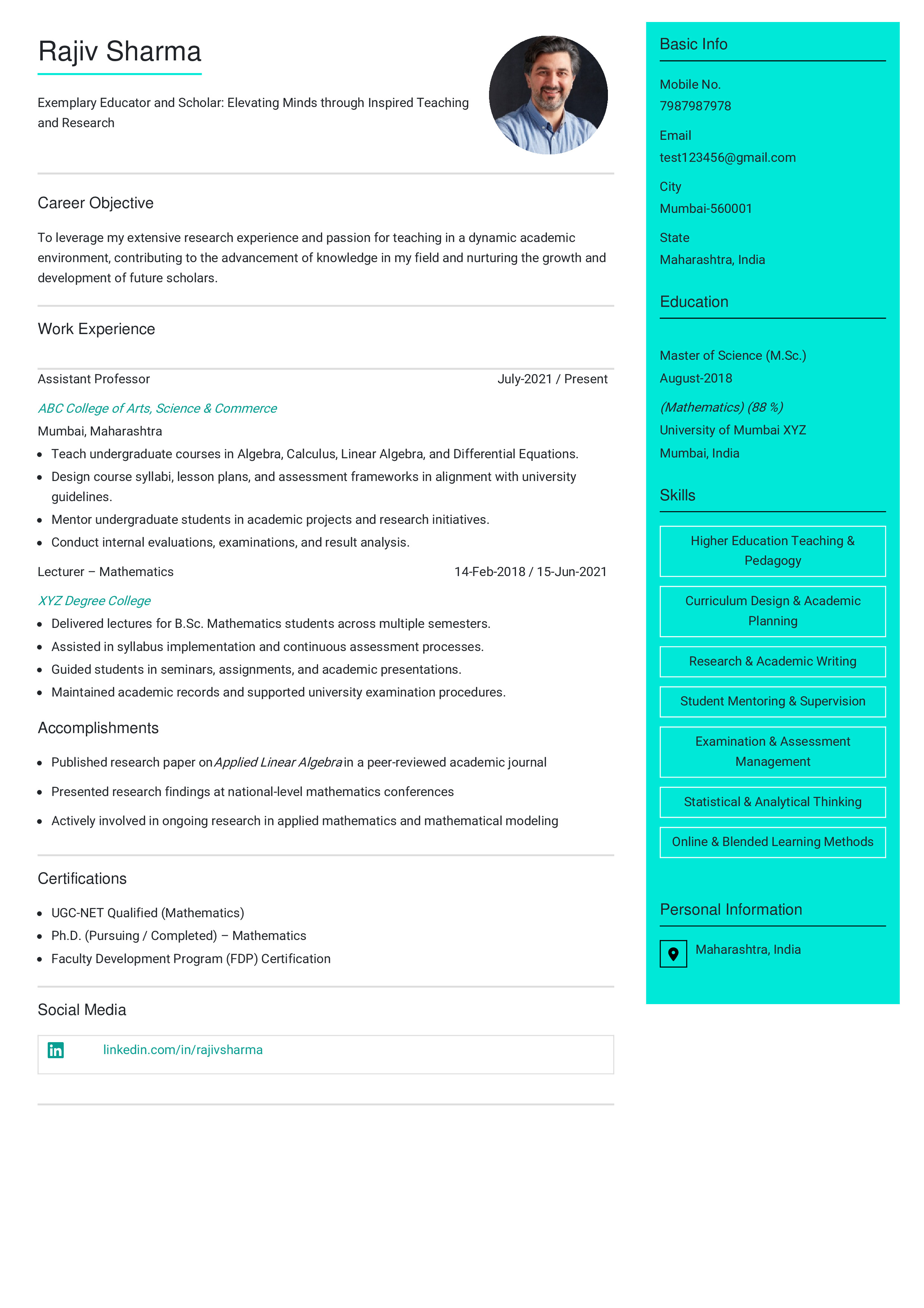
Crafting your professor resume should not resemble the process of assembling a tenure review packet. It is essential to highlight your teaching achievements, research contributions, and publications in a manner that hiring committees can easily understand, without resorting to a 50-page CV.
In this guide, we will provide you with practical resume tips and engaging templates. Get ready to become the candidate that every university aspires to have on their team. Advanced academics, welcome to the realm of advanced resume writing.
Consider the following steps when writing a professor's resume.
1. Examine the job description closely.
Initiate the process of crafting a professor's resume by thoroughly reviewing the job description. It outlines the attributes, qualifications, and experiences that an employer seeks in the ideal candidate. By grasping these requirements, you can more effectively tailor your resume to align with the employer's expectations. Look for relevant keywords and phrases associated with the professor position, such as research experience, teaching experience, or subject matter expertise, and strive to integrate these into your resume.
2. Include a professional resume header
The subsequent step involves incorporating a resume header at the top of your document. This should contain your full name, contact number, email address, city, and a professional title, such as Distinguished Professor of English Literature or Adjunct Professor in Business Management. Keep this section succinct and refrain from including any extraneous personal information. Consider making your name slightly larger or bolder than the rest of the text to attract attention. A well-structured header ensures that hiring personnel can easily identify and reach you.
3. Compose the best professional resume summary.
Following the header, a professional summary should be included. This section acts as a brief overview of your career, qualifications, and significant achievements. Summarize your experience as a professor, areas of expertise, notable accomplishments, and essential skills. Aim to keep this section concise, targeting around three to four sentences. An engaging summary provides employers with a quick glimpse into your suitability for the professor role and motivates them to examine your complete resume.
4. Detail your work experience.
In the experience section, outline your professional background, starting with your most recent position. For each role, include your job title, the name of the institution, its location, and the dates of employment. Describe your responsibilities, achievements, and skills acquired, emphasizing those that correspond with the professor's role. Highlight instances where you made significant contributions, such as impactful research, successful grant applications, or positive outcomes.
5. Emphasize pertinent skills
After detailing your work experience, establish a skills section. In this section, enumerate the assistant professor skills for resume that contribute to your effectiveness as a professor. These may encompass hard skills, such as expertise in the subject matter and research capabilities, as well as soft skills, including communication, leadership, and mentoring. Ensure to include skills pertinent to the professor position that align with the specifications outlined in the job description.
6. Provide your educational background
In the education segment, outline your academic credentials. Specify the degree obtained, the name of the university or institution, and the year of graduation. For a professorial position, most employers anticipate a doctoral degree in a relevant discipline. If you have attended several educational institutions or hold multiple degrees, prioritize highlighting those that are most applicable to the professor role.
7. Detail certifications
Should you have any additional certifications, awards, or honors that are relevant to the professor position, present them in a distinct section. This may encompass different types of teaching certificates, accolades for research publications, or acknowledgments for contributions to your discipline. These supplementary qualifications further affirm your commitment and expertise in your field.
8. Review and refine
The concluding step entails thoroughly proofreading and refining your resume. Scrutinize for any spelling, grammatical, or formatting mistakes. Ensure that all information provided is accurate and current. A meticulously edited, error-free best professor resume positively reflects your professionalism and attention to detail. If feasible, request a colleague or mentor to review your resume, as they may identify errors that you have missed.
Tips for writing a professor's resume
-
Emphasize your academic specializations: If you possess expertise in particular academic fields or disciplines, such as a focus on neuroscience, early childhood education, or environmental science, make sure this is prominently displayed on your resume.
-
Quantify your achievements and impact: It is essential to utilize metrics to measure your accomplishments. Include the number of students you have instructed, the courses you have created, or the research grants you have obtained. Additionally, underscore any notable enhancements in student success rates or program improvements that you have spearheaded.
- Select an appropriate resume template for job: Choose a professional resume template that aligns with the academic discipline and position for which you are applying. Maintain a clean and professional format, utilizing clear headings and bullet points to satisfy various resume scanning systems. Focus on content, emphasizing your teaching and research experiences, skills, and certifications.
FAQ’s
Q1. What elements should a professor's resume contain?
A. Your resume as a professor ought to feature your contact details, a concise summary statement, specific areas of expertise, educational qualifications, positions previously held, published works, awards and recognitions, as well as professional affiliations. Additionally, you may want to include pertinent courses you have taught, your research interests, or any community service activities.
Q2. Is it permissible to incorporate non-academic work experience in my resume for a professor position?
A. If the non-academic work experience enhances your qualifications as a professor or pertains to the role you are pursuing, it is advisable to include it. Highlight how these skills can be applicable in an academic context.
Q3. What is the appropriate length for a professor's resume?
A. Considering the extensive experience that many professors possess, a two-page resume is deemed acceptable. For individuals with a significant number of publications, a separate curriculum vitae can be utilized to elaborate on these works, while providing a concise mention and reference within the resume.
Q4. Should I customize my resume for every job application?
A. Certainly. Each job description varies, and personalizing your resume for each position demonstrates your genuine interest. Modifying your resume enables you to emphasize the most pertinent skills and experiences for each particular role.
Q5. What strategies can I employ to enhance the visibility of my professor's resume?
A. Emphasize accomplishments rather than merely listing duties. Whenever feasible, incorporate quantifiable metrics to demonstrate success in areas such as teaching, mentoring, or research activities. Additionally, a resume that is well-structured, tidy, and devoid of errors consistently attracts attention.