


Table of Contents
▼- Interior Designer Resume Examples & Writing Guide
- Steps of writing a perfect resume
- Problems you might face when writing your interior designer resume and solutions
- Conclusion
- Interior Designer Cover Letter Frequently Asked Questions
- Q1. What should be the appropriate length for my Interior Designer resume?
- Q2. What is the most effective method for structuring a resume for an interior designer?
- Q3. What are the most prevalent resume errors that Interior Designers should steer clear of?
Interior Designer Resume Examples & Writing Guide
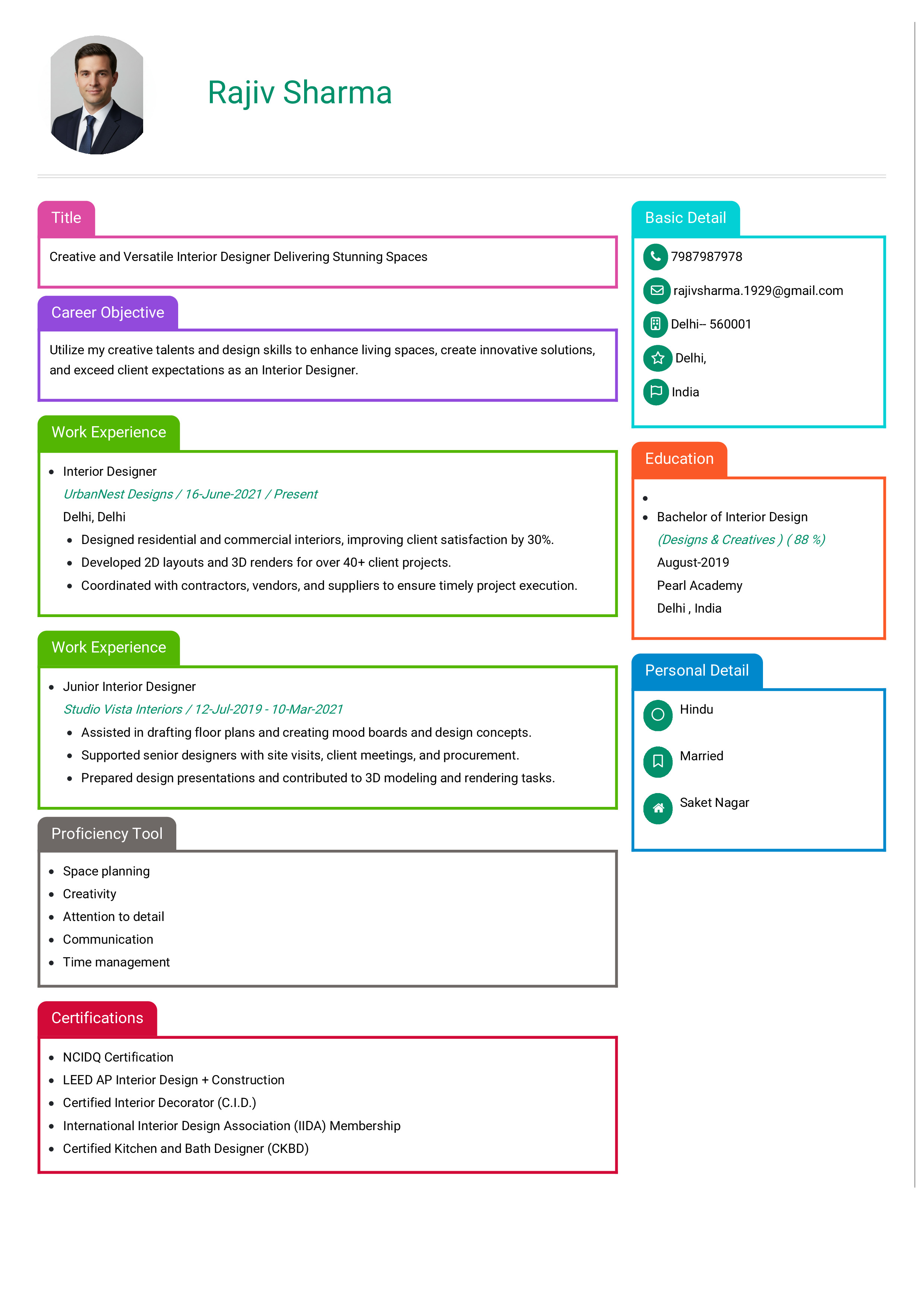
You are fully aware of what is required to convert a house into a home. You are prepared to utilize your aesthetic sense and design expertise effectively. Still, there are no issues. Your resume is the project you find challenging. Whether it has been some time since you last updated your resume or you are crafting one fresh, creating an outstanding interior design resume can be demanding. Fortunately, there is no need for concern. This article aims to assist you in transforming your interior designer resume into an impressive representation and suggest some tips for writing a great resume.
Steps of writing a perfect resume
1. Choose the best format.
Every project requires a base plan, and your interior designer resume format is no exception. In 99% of cases, we recommend opting for the reverse-chronological format for your interior designer resume. This format emphasizes your latest work experience, roles, and achievements, which is exactly what hiring managers are anxious to review. Furthermore, it is the most advised format among hiring managers worldwide, making it a sound choice.
2. Add needful contact information.
Write your complete name with accurate spelling. The title on your resume should relate to the position you are applying for. When submitting an application for a job overseas, always start your phone number with the correct dialing code. Your email address should reflect some variation of your first and last name. Avoid using nicknames, humor, or references to your favorite TV show. Make sure that you include a link to your online portfolio. If you are applying for a remote position or a job for which you are willing to relocate, be sure to specify that in your resume.
3. Craft an impactful resume summary and objective.
As an interior designer, your motive is for your clients to enter the space you have created and immediately exclaim, "Wow."
There are two ways you can go about this:
- Resume summary: Interior designers who are experienced may utilize the resume summary to highlight their years of professional working experience, key skills, and notable achievements.
- Resume objective: For those who are new to the field of interior design, it is recommended to focus on your career aspirations and educational accomplishments rather than your working experience. A resume objective is the most appropriate option for recent graduates and individuals transitioning careers.
4. Add your interior designer experience in resume
Review the job description thoroughly to comprehend precisely what the organization seeks. Highlight your accomplishments, demonstrate your true capabilities, and illustrate how you can add value to the company. Enhance the credibility of your achievements by supporting them with data and statistics. To ensure your experience section is prominent, employ impactful action verbs.
What to add in your resume as a fresher in the field?
If you are seeking your initial position in interior design, you may be worried about what to include in your work experience to include on your junior interior designer resume. However, while work experience is important, it is still possible to show your abilities as an interior designer without it. Simply utilize that blank area in your interior designer resume fresher by including other sections that emphasize your skills and confidence for the profession, such as internships, academic projects, and extracurricular activities.
5. List your educational background.
Interior designers are required to possess a degree or equivalent qualifications to begin their careers. However, it is not necessary to elaborate on your educational knowledge if you have applicable work experience. The hiring manager will give preference to your work experience, portfolio, and skills over your educational details. Therefore, it is advised to keep your education section short, starting with your most recent qualification.
6. Add portfolio
As an interior designer, you likely possess a portfolio that highlights your finest work. Generally, it suffices to include a link to your portfolio website within your contact details. Many interior designers create their own websites to express their aesthetic sensibilities, and numerous interior design portfolio templates are available should you wish to pursue a similar approach.
7. Showcase your skills
Next, it is essential to focus on interior design skills in resume. Your skills demonstrate what you can provide to your prospective employer. Whether it pertains to your ability to communicate effectively within a team or your proficiency with certain software, your interior design skills must always be included in your resume. However, it is unnecessary to enumerate every single skill you possess. Instead, you should customize your skills to align with the specific job requirements.
Hard skills
- Computer-Aided Design (CAD)
- 3D Modeling
- 3ds Max
- AutoCAD
- V-Ray
Soft skills
- Communication
- Creativity
- Problem-solving
- Client management
- Active listening
Problems you might face when writing your interior designer resume and solutions
- When illustrating practical experience, the difficulty resides in presenting this experience in a written format instead of a visual portfolio format. Therefore, utilizing job-specific tools such as AutoCAD, SketchUp, or other 3D modeling software is essential.
- Emphasize your design-specific abilities, as a remarkable interior designer's resume must also showcase particular skills such as space planning, color theory, and expertise in textiles.
- Numerous interior design projects are required to adhere to local safety regulations and building codes. Exhibiting knowledge and comprehension of these codes presents a considerable challenge. Obtaining certification from organizations such as the National Council for Interior Design Qualification (NCIDQ) can assist in addressing this concern.
- Failing to include a direct link or reference to an online portfolio on platforms such as Behance, Pinterest, or a personal website diminishes the effectiveness of the resume. Therefore, it is essential to incorporate a link to your interior designer resume portfolio.
- Numerous well-known job boards utilize keyword filtering for resumes. Given the visual and conceptual aspects of interior design, it may prove challenging to seamlessly integrate the appropriate keywords without rendering the resume awkward. Additionally, platforms such as Indeed, Glassdoor, or LinkedIn may not allow direct links to portfolios.
Conclusion
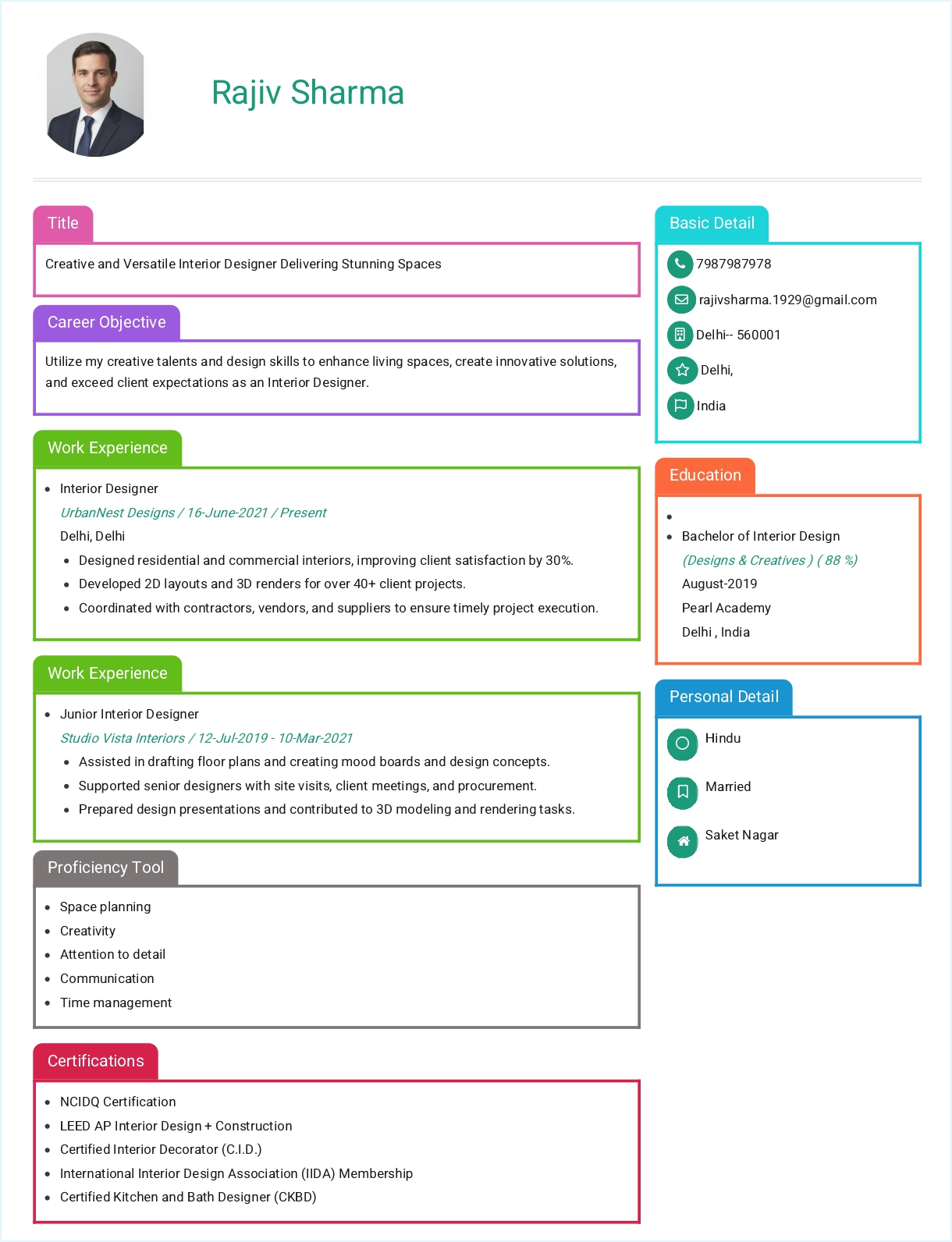
An effectively designed, experienced interior designer resume transcends a mere enumeration of qualifications—it serves as a testament to your creativity and proficiency. By highlighting your design abilities, relevant experience, and project portfolio, you can produce a document that distinguishes itself in a competitive landscape. Dedicate time to customize it for each opportunity, and ensure you prominently display your finest work. With the appropriate strategy, your application can pave the way to thrilling new design projects and career advancements. If you want to make your resume stand out from others, check this interior designer resume maker online.
Interior Designer Cover Letter Frequently Asked Questions
Q1. What should be the appropriate length for my Interior Designer resume?
A. In contrast to graphic design resumes, which may be more creative and extensive, Interior Designer resumes ought to be succinct. Those at the entry level should limit their resumes to one page, while experienced designers may extend theirs to two pages.
Q2. What is the most effective method for structuring a resume for an interior designer?
A. Chronological formats are suitable for seasoned designers who have a history with reputable firms, whereas functional formats are more advantageous for individuals transitioning careers or those who have employment gaps.
Q3. What are the most prevalent resume errors that Interior Designers should steer clear of?
A. The distinction between generic portfolios and tailored work samples is the most significant factor that separates candidates who are overlooked from those who are invited for interviews.