JobsCruze
13/01/2026
11:46am

JobsCruze
30/12/2025
11:55am

JobsCruze
29/12/2025
11:40am
Subscribe to our newsletter to receive job search advice, career tips, resume and cover letter guidance, and interview tips—All in your inbox! Subscribe here.

Writing a good CV or Resume can be confusing for students and job seekers. Many people ask, resume or CV meaning? or are CV and resume interchangeable? The truth is, both are important documents, but they are not the same.
When preparing for an interview, knowing the difference between CV and Resume is very important. If you understand the basics, you can create the right document and make a strong impression on employers.
This blog will explain CV vs Resume understanding the differences and definitions sample with simple examples so you can easily understand.
|
Table of Contents
|
A CV means Curriculum Vitae. It is a detailed document that shows your entire academic and professional journey.
A CV is usually longer than a resume.
It is often 2–3 pages or more.
It includes your education, skills, research, projects, and achievements.
In simple words, a CV is like a complete story of your career. That’s why when people ask, what is the difference between a CV and a Resume, one answer is the length and detail level.
Must Read: Your Ultimate Guide to Writing a Cover Letter with No Experience
A CV often includes:
Personal Information (Name, Contact details)
Career Objective
Academic History
Projects and Training
Languages
Hobbies and Interests
This is why people also search for CV format when making their document.
Must Read: How to Write Qualification in Resume - ATS Friendly
A Resume is a shorter and more focused document. It is usually 1–2 pages long and highlights only the information needed for a job.
It usually includes:
Career Objective
Profile Summary
Work Experience
Achievements
Key Skills
This explains the resume cv meaning. A Resume is direct and highlights only the important skills and achievements.
Must Read: Top Project Manager Resume Writing Tips Land Your Dream Job!
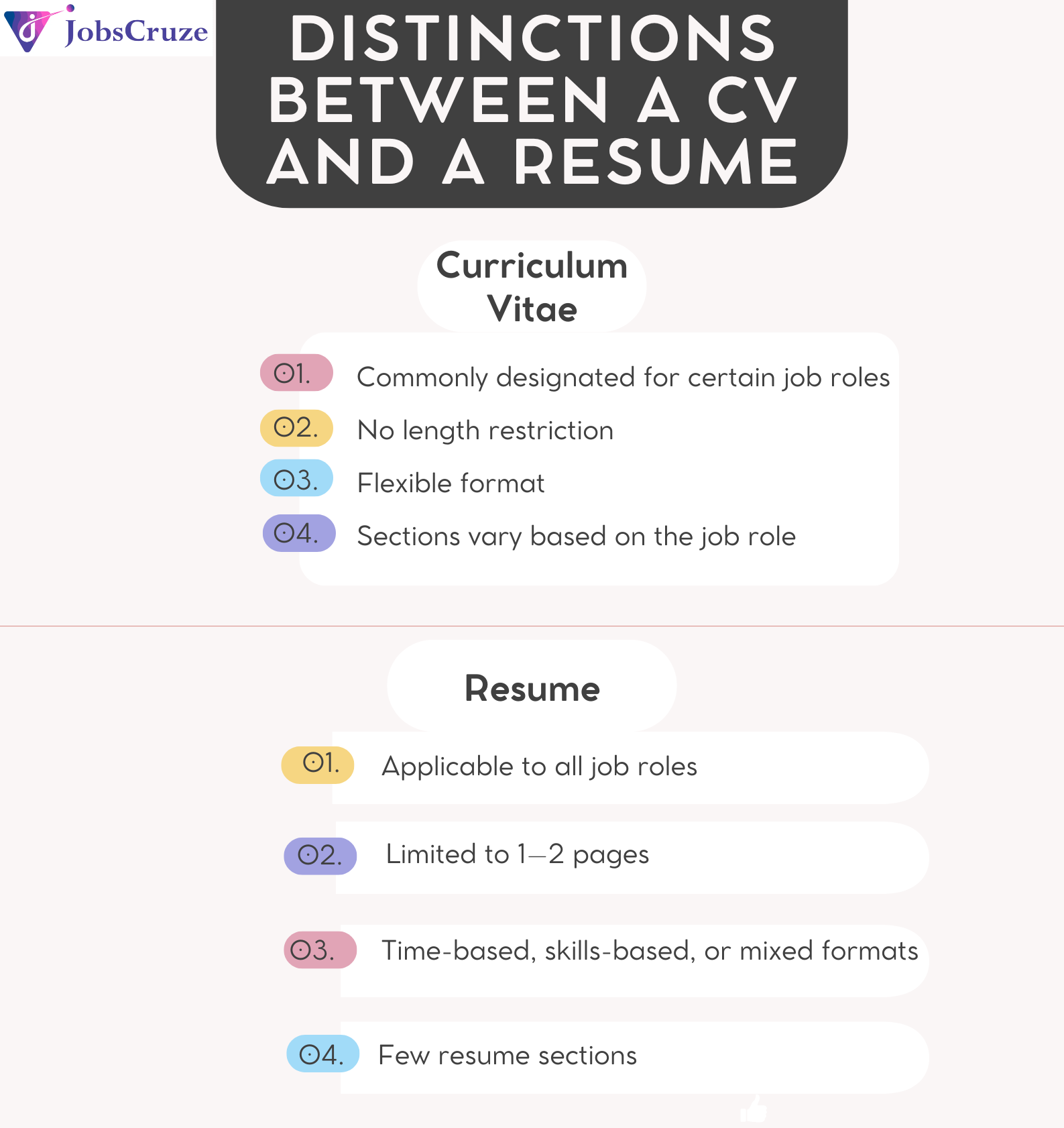
Students often ask: what is the difference between a CV and a Resume explained. Let’s make it simple:
| CV | Resume |
| 2-3 pages or more | 1-2 pages |
| Full details of your career | Focused on job-related details |
| Used in academics, research, or fresher jobs | Used in professional and corporate jobs |
| Includes all achievements and projects | Includes only relevant skills and work experience |
This table shows the CV and Resume difference clearly.
Some students also ask about 10 differences between CV and Resume. The main idea is – CV is detailed, Resume is short and targeted.
Must Read: 10 Important Points recruiter look in your cv
Here’s a simple CV vs Resume example:
CV Example: A college student applying for a research fellowship includes all academic history, projects, and training.
Resume Example: An IT professional applying for a corporate job highlights only work experience, skills, and achievements.
This explains the CV resume difference in practical terms.
The choice depends on whether you are a fresher or experienced:
Freshers: A CV works better as it shows academic history, training, and projects.
Experienced Candidates: A Resume is better as it focuses on work experience and achievements.
So, what is the difference between a CV and Resume? The answer depends on your career stage.
.png)
Many students wonder, are CV and Resume interchangeable? The answer is no.
In some countries, like the USA, employers mostly ask for a resume.
In other countries, like India or Europe, a CV is often required for academic or government jobs.
So, while both are job documents, the resume and CV difference makes them useful for different purposes.
Another common question is what is the difference between CV and resume writing?
CV Writing: Focus on a detailed story of your career. Add all education, skills, and achievements.
Resume Writing: Focus on keywords, short sentences, and only job-relevant details.
That is the basic difference between CV and Resume writing style.
To make it simple for students, here’s a quick CV vs Resume understanding the differences and definitions example:
A CV = Detailed story of your life, good for freshers or academic jobs.
A Resume = Short summary, good for professional or corporate jobs.
So, if someone asks, what is the difference between a CV and Resume, you can explain it in one line: CV = Detailed, Resume = Concise.
Here are 10 difference between CV and Resume to remember:
CV is longer, Resume is shorter.
CV includes all details, Resume includes only relevant details.
CV is used in academics, Resume is used in jobs.
CV has a fixed format, Resume is flexible.
CV includes education in detail, Resume highlights skills.
CV shows research and training, Resume shows work achievements.
CV is 2–3 pages, Resume is 1–2 pages.
CV is static, Resume can be customized for each job.
CV is common in Europe, Resume is common in the USA.
CV = Complete profile, Resume = Job-focused profile.
This list clears all doubts about the cv resume meaning and usage.
For academic roles: Use a CV.
For corporate or private jobs: Use a Resume.
For internships: Freshers can use a CV.
For professional positions: Use a Resume.
Always check the employer’s requirements before sending your document.
Here’s a simple CV format:
Name:
Contact:
Career Objective:
Education:
Work Experience:
Projects:
Skills:
Languages:
Hobbies:
Here’s a simple Resume format:
Name:
Contact:
Profile Summary:
Career Objective:
Work Experience:
Skills:
Achievements:
Certifications:
These CV vs Resume examples show the clear structure difference.
In this article on CV vs Resume understanding the differences and definitions sample, we discussed:
What is the difference between a CV and a Resume explain
CV and Resume difference with examples
What is the basic difference between CV and Resume writing
10 difference between CV and Resume
So, to summarize:
CV = Detailed (Education, Research, Projects, Skills)
Resume = Short and Targeted (Work Experience, Skills, Achievements)
If you are still confused about what is the difference of a CV and Resume, just remember this rule:
CV = Long and detailed for academic jobs.
Resume = Short and focused for professional jobs.
Both are important in your career journey. The better you understand the difference between Resume and CV, the easier it will be to choose the right one and impress recruiters.
The JobsCruze Logo is already a Spirited Signature that proudly headlines the Vision we pursue for and those we serve and stand for.

📈 70% Faster Shortlisting by Recruiters

📈 70% Faster Shortlisting by Recruiters

🎯 Smart preparation for job interviews

🚀 Plan and grow your career with AI

How to Build Your Resume
Whether you're navigating a recent job loss, planning a career shift, or exploring new opportunities, JobsCruze provides all the tools you need to craft a standout resume.
We recommend starting fresh with JobsCruze, but if you already have a resume, you can easily build on it. Our flexible options support you no matter where you're starting from.
1. Start from Scratch
1. Go to your JobsCruze dashboard.
2. Click the "Create New Resume" button at the top center.
3. Fill out the form with your First Name, Phone Number, Email Address, and Career Objective.
4. Click the "Next" button to proceed.
⭐ Tip: Make the most of the “Auto Suggestion Keywords” feature to enhance your content.
2. Use an Existing Resume
If you already have a resume you'd like to use as a base, we recommend copying and pasting your content into the JobsCruze builder for best results.
⭐ Tip: The “Auto Suggestion Keywords” tool is also available here to help optimize your resume.
ℹ Note: Please keep in mind that results may vary when importing content from an existing resume.
Steps to Download Your Resume as a PDF:
1. Log in to your JobsCruze dashboard.
2. Click on "Create New Resume" or open a previously saved resume.
3. Navigate to the "Next" tab.
4. Select "Create Resume PDF" to generate the file.
5. Click the 'Download' button located in the bottom left corner.
6. Your resume is now ready to be shared as a polished PDF document!
Free Plan
Get started at no cost-no payment registration required! With our Free plan, you can:
Weekly Plan (Most Popular)
Enjoy unlimited access to all premium features, ensuring no restrictions when creating your ideal resume.
Monthly Plan
Keep your career journey smooth and uninterrupted. The Monthly plan provides full access to all JobsCruze features with a simple one-time payment.
Yearly Plan (Best Value)
Unlock unlimited access to all premium features for a full year, ensuring maximum flexibility and convenience.
How Can I Cancel My JobsCruze Subscription?
https://jobscruze.com/policy-refund-cancelWhile we’d be sad to see you go, we totally understand—whether you're taking a break from job hunting or have just landed a new opportunity, congratulations!
Remember, JobsCruze will always be here when you need us again.
To cancel your subscription, simply reach out to us at customersupport@jobscruze.com
What Happens After Cancellation?
Once your current billing cycle ends, your account will automatically switch to the JobsCruze Free Plan. Please note that canceling or downgrading your subscription will remove access to premium features.
Welcome to the JobsCruze Resume Builder Support Center! Whether you're crafting a standout resume, prepping for an interview, or building your career website, our team is ready to support you every step of the way.
📞 Real-Time Support Channels
Get instant assistance through any of our support lines:
📱 Mobile Support: +91-8007867303
💬 WhatsApp Chat: +91-8623977603
📧 Email Support: customersupport@jobscruze.com
(Average response time: within 12-24 hours)
📧 Priority Support: piyush.khandelwal@jobscruze.in
Live Agent Availability:
Monday to Saturday | 9:00 AM – 9:00 PM (IST)
🧠 Smart Support - 24/7
Chat with our AI assistant anytime-quick, smart, and always ready. Need a real person? Just type "Talk to Support" during business hours.
📌 Supported Products
We offer real-time support for all our powerful career tools:
Receive assistance with upgrading a JobsCruze plan and resolving billing issues.
Free Plan
Get started at no cost-no payment registration required! With our Free plan, you can:
Weekly Plan (Most Popular)
Enjoy unlimited access to all premium features, ensuring no restrictions when creating your ideal resume.
Monthly Plan
Keep your career journey smooth and uninterrupted. The Monthly plan provides full access to all JobsCruze features with a simple one-time payment.
Yearly Plan (Best Value)
Unlock unlimited access to all premium features for a full year, ensuring maximum flexibility and convenience.
• Terminate Subscription
How Can I Cancel My JobsCruze Subscription?
While we’d be sad to see you go, we totally understand—whether you're taking a break from job hunting or have just landed a new opportunity, congratulations!
Remember, JobsCruze will always be here when you need us again.
To cancel your subscription, simply reach out to us at customersupport@jobscruze.com
What Happens After Cancellation?
Once your current billing cycle ends, your account will automatically switch to the JobsCruze Free Plan. Please note that canceling or downgrading your subscription will remove access to premium features.
FAQs
What if I cancel my Lifetime Plan?
Downgrading a Lifetime plan is permanent and will take effect immediately. Please consider this carefully before proceeding.
Will I still have access to Pro features after canceling?
Yes! You’ll retain full access to all Pro features until the end of your current subscription period.
Explore JobsCruze's powerful AI-driven tools designed to elevate your experience.
Utilizing Resume Analysis
Resume Analysis evaluates your resume on a scale from 1 to 100, offering more than just a number-it's a detailed insight into the strength and quality of your resume. Think of it as a personalized report card that helps you fine-tune your resume for job success.
By analyzing 23 key criteria valued by hiring managers, this tool gauges your job readiness with a precise score. This guide will help you understand how your score is calculated and how you can improve it using real-time analysis and best practices.
Let's dive in and unlock the secrets to a stronger, more competitive resume!
Why Is a Resume Score Important?
Staring at your resume and unsure what needs improvement? A resume score provides you with instant, personalized feedback based on your experience level, target role, and industry. It's like having a career coach that helps you stand out in a competitive job market.
Scoring Scale:
What Influences Your Resume Score?
Your resume is evaluated across five main categories:
Each category includes 23 detailed audits that influence your score—from formatting choices to grammar to keyword usage.
Top Content Audits:
Formatting Must-Haves:
Optimization Techniques:
Best Practice Essentials:
Application Ready
This is your final checkpoint. It reflects how prepared your resume is to apply for jobs, combining all audit results into one comprehensive readiness score.
How to Improve Your Resume Score
Once you understand where your resume stands, prioritize critical issues first to see the biggest impact. The Resume Analysis tool highlights what needs fixing—and with AI support, revising your resume becomes fast, easy, and highly effective.
• Linkedin Optimization Services
Enhancing your LinkedIn profile is crucial for standing out in today's competitive job market. JobsCruze offers LinkedIn Optimization Services designed to showcase your skills, achievements, and expertise, making your profile more appealing to recruiters and potential employers.
Benefits of Optimizing Your LinkedIn Profile:
How to Optimize Your LinkedIn Profile:
By following these steps and utilizing JobsCruze's LinkedIn Optimization Services, you can create a profile that effectively represents your professional brand and attracts the right opportunities.
FAQs
What does a LinkedIn Optimization Service include?
A LinkedIn profile optimization service typically includes improving your headline, summary, work experience, and skills sections. It also involves conducting keyword research to ensure your profile ranks higher in searches, which is similar to LinkedIn SEO optimization.
For more information, please refer to our privacy policy.
• Personalized Consultation Services
At JobsCruze, we offer a comprehensive career advancement package designed to empower both newcomers and seasoned professionals in their interview journeys. Led by Piyush Khandelwal, our Personalized One-on-One Consultation program provides individualized coaching, including:
One-on-One Interview Preparation Sessions: Engage in personalized sessions to hone your interview skills and strategies.
Mock Interview Questions and Answers: Practice with tailored mock interviews to build confidence and readiness.
ATS-Friendly Resume and Cover Letter Creation: Develop application materials optimized for Applicant Tracking Systems to enhance visibility.
LinkedIn Profile Optimization: Refine your LinkedIn presence to attract potential employers and networking opportunities.
AI Resume Builder Access: Utilize advanced AI tools to craft compelling resumes efficiently.
Top 50 HR Job References: Gain access to a curated list of top HR job references to aid your job search.
Job Portal Search Applications: Receive assistance with job applications on various portals, tailored to your desired roles.
Our consultants work closely with you to develop a personalized action plan aligned with your career aspirations. With continuous support and expert insights, we guide you every step of the way to ensure you reach your career goals with confidence.
How Our Personalized Consultation Services Work
Initial Assessments: We begin with a thorough evaluation of your career goals, background, and specific needs to tailor the consultation to your unique requirements.
Personalized One-on-One Sessions: Engage in dedicated sessions with our career experts to discuss your objectives and receive customized guidance.
Tailored Action Plan: Based on our consultations, we develop a strategic action plan with actionable steps to help you achieve your career aspirations.
Ongoing Support: We provide continuous support as you implement your action plan, ensuring you stay on the path to success and personal growth.
Frequently Asked Questions (FAQ)
What is a personalized resume consultation, and how does it work?
A personalized consultation is a one-on-one session with an expert who reviews your resume and offers tailored advice to enhance it. During the session, the consultant analyzes your experience, skills, and career goals to ensure your resume aligns with industry expectations. This process supports your career development by highlighting your unique strengths. You’ll receive actionable tips on formatting, phrasing, and showcasing accomplishments, ensuring your resume stands out.
Why should I opt for a Personalized Consultation instead of using an online resume template?
Online resume templates provide a generic structure but lack the personal touch needed to reflect your unique abilities. A personalized consultation goes beyond templates, focusing on your skills and career development goals. Our experts create suggestions to highlight your achievements and position you for success in your chosen field. This customized approach ensures your resume aligns with your aspirations and impresses potential employers.
What can I expect from a one-on-one consultation session?
During a session, you’ll work closely with a resume expert who will analyze your current resume and provide tailored feedback. They’ll offer insights into how your resume can better support your career development goals. You’ll also gain guidance on using impactful keywords and showcasing your accomplishments effectively. This personalized consultation ensures your resume reflects your full potential.
How long does it take to receive comments on my resume?
Typically, you’ll receive feedback within 1-2 business days after the personalized consultation session. Our experts thoroughly review your resume, ensuring it aligns with your life coaching or career development needs. If further revisions are needed, we guide you through the process to ensure your resume is ready to make a strong impact.
Can your consultation services help with resumes for specific industries or roles?
Absolutely! Our experts have experience across a variety of fields, including IT, finance, healthcare, and more. Whether your focus is on career development or transitioning into a new industry, we tailor your resume accordingly. This personalized consultation ensures your resume matches the expectations of your target role, increasing your chances of success.
Do you provide guidance on cover letters and Linkedin profiles during the consultation?
Yes, our services extend beyond resumes. We can help you create compelling cover letters that complement your resume and align with job descriptions. We also offer LinkedIn profile optimization to strengthen your online presence and enhance your career development opportunities. Our personalized consultation ensures consistency and professionalism across all your career-related materials.
How do I schedule a personalized resume consultation?
Scheduling a session is simple. Visit our website and navigate to the Personalized Consultation section. Choose your favorite date and time, and fill out the booking form. This step is essential to kickstart your career development journey. Once booked, you’ll receive a confirmation email with session details. Our team is available to assist if you have any questions.
What are the fees for a Personalized Consultation, and are there any discounts available?
The fees for our personalized consultation services vary depending on the level of support required. Our pricing is designed to fit various budgets, starting at an affordable rate for basic resume reviews. To support your career development, we also offer discounts for first-time users and special promotions. Check our website or contact us to learn more about our current offers.
• Save your resume
Saving and sharing your resume in PDF format is one of the most effective and widely adopted practices. Choosing a PDF ensures your resume remains ATS-compliant, allowing applicant tracking systems to scan and read your information accurately.
Additionally, PDF files preserve your layout and design, keeping your resume visually consistent and professional across all devices and when printed—making a strong impression on potential employers.
Steps to Download Your Resume as a PDF:
FAQs
What is the best format for a resume?
We strongly recommend using the PDF format. It maintains your original design and formatting, unlike other file types that may display inconsistently across software versions. PDF gives you peace of mind, ensuring your resume appears exactly as intended when viewed by hiring managers.
Discover how to make the most of JobsCruze while creating your professional resume.
• Create Resume
How to Build Your Resume
Whether you're navigating a recent job loss, planning a career shift, or exploring new opportunities, JobsCruze provides all the tools you need to craft a standout resume.
We recommend starting fresh with JobsCruze, but if you already have a resume, you can easily build on it. Our flexible options support you no matter where you're starting from.
1. Start from Scratch
1. Go to your JobsCruze dashboard.
2. Click the "Create New Resume" button at the top center.
3. Fill out the form with your First Name, Phone Number, Email Address, and Career Objective.
4. Click the "Next" button to proceed.
⭐ Tip: Make the most of the “Auto Suggestion Keywords” feature to enhance your content.
Note: Please keep in mind that results may vary when importing content from an existing resume.
2. Use an Existing Resume
If you already have a resume you'd like to use as a base, we recommend copying and pasting your content into the JobsCruze builder for best results.
⭐ Tip: The “ Auto suggestion Keywords” tool is also available here to help optimize your resume.
ℹ Note: Please keep in mind that results may vary when importing content from an existing resume.
• Templates
Professionally Designed Templates for Job-Winning Resumes
Job hunting can be overwhelming, but with JobsCruze’s expertly crafted resume templates, you’re never alone. Our templates are designed with precision to cater to a wide range of industries, experience levels, and career stages. Each layout serves as a reliable starting point to help you build a polished, professional resume that stands out to employers.
Not only do these templates save you time and reduce stress, but they also simplify the resume-building process. No need for design skills or resume-writing experience—our intuitive platform makes it easy to tailor each section to highlight your strengths and qualifications.
Whether you're crafting a resume from the ground up or updating your current one, JobsCruze templates offer the ideal foundation to help you create a compelling resume that opens doors to new opportunities.
Get ready to impress hiring managers with a high-quality, professionally designed resume—powered by JobsCruze.
What is ATS-Optimization?
Let’s break it down: ATS stands for Applicant Tracking System—a type of software used by employers to manage and filter incoming resumes. These systems scan resumes for key information such as specific keywords, formatting, and job-relevant details to decide which candidates move forward.
An ATS-optimized resume is structured and formatted in a way that ensures it can be read and interpreted correctly by these systems. Using a JobsCruze ATS-friendly template significantly boosts your chances of passing this first stage and landing in front of hiring managers.
Explore Our ATS-Optimized Resume Templates
1. Slope
The Slope template is a timeless favorite among over 3 million job seekers. Designed to be both ATS-friendly and visually impactful, it strikes the perfect balance between form and function—ideal for those who want a classic layout that doesn’t compromise on results.
2. Skyhigh
Need to share more experience or qualifications without overwhelming the design? The Skyhigh template offers 20% more content space than Slope, making it the best pick for professionals with rich work histories and detailed skill sets.
3. Pluviophile
This template delivers a modern design flair while staying fully ATS-compliant. With its sleek appearance and flawless compatibility with hiring software, Pluviophile ensures your resume stands out without being filtered out.
4. Aurora
The Aurora template merges clean aesthetics with high content density, letting you present a wealth of information in a compact, easy-to-read format. Ideal for all industries, it’s a great choice for making a lasting impression.
FAQs
What makes a resume effective?
A strong resume clearly communicates your skills, experiences, and achievements in a format that both hiring managers and ATS software can quickly understand. With JobsCruze, you can take advantage of our Resume Analysis tool, which scores your resume in real time to help you optimize it for job applications.
Why does resume design matter?
A well-designed resume is crucial—it draws attention, enhances readability, and signals professionalism. It also ensures compliance with ATS standards. With JobsCruze’s templates, you get the perfect blend of visual appeal and technical precision to maximize your job search success.
Find support for updating your password, email address, or setting up your JobsCruze profile.
• Update your password
Step 1:If you registered your account using an email address, you can reset or update your password by following these simple steps.
Step 2:Visit the JobsCruze homepage and navigate to the Login page.
Step 3:Click on the 'Forgot Password' option.
Step 4:Enter your registered email address on the next screen and click the 'Submit' button.
Step 5:Check your inbox for an email from JobsCruze and click the link or button provided to reset your password.
Step 6: Enter a new password on the password reset page and confirm the change.
Once your password is successfully updated, you'll be redirected to the login page where you can access your account using your new credentials.
AI Resume writer Guidance
• What Does the JobsCruze AI Resume Writer Do?
JobsCruze AI Resume Writer is powered by the advanced OpenAI GPT-3 neural network, a strong language model that creates text similar to what a human would write.
Put simply, this tool does exactly what you'd expect—it helps you write your resume automatically. Just enter your job title, click on 'Use AI Writer,' and it will generate several bullet points for your work experience section. Don’t like a few? You can edit, delete, or click again for new ones. Need to add more? Just click again to expand the section.
Since the content is created by AI, it’s a good idea to make some final edits to personalize it. Still, it’s a great way to start building a solid first draft quickly and easily.
Is the AI Resume Writer Available at No Cost?
Free accounts come with a limited number of AI uses. However, premium plans—starting at ₹749 per month—offer a much larger quota of AI-generated resume content. Credits are automatically added at the beginning of each billing cycle, whether you choose monthly, quarterly, or yearly plans.
Since GPT-3 is a paid service provided by OpenAI, each use of the AI incurs a cost. To cover these expenses, we set a monthly limit on how many times you can use the AI Resume Writer.
How Does the AI Resume Writer Work?
The JobsCruze AI Resume Writer creates tailored work experience content based on the job title you enter.
Here’s how it works:
• Sign up or log in to your JobsCruze account. From the dashboard, go to Your Documents and click Create New.
• In the Work Experience section, type in your job title and click Use AI Writer. The AI will generate several bullet points for your resume.
• Don’t like the suggestions? You can edit or delete them and click the button again for new options.
• Want to expand the section? Click the button again to add more content.
Our AI Resume Builder is easy to use, generates unique results each time, and writes in a natural tone that closely resembles a professionally written resume.
How Can I Create an AI-Generated Resume?
Creating a resume with the JobsCruze AI Resume Writer is easy. Just follow these steps:
• Sign up or log in to your JobsCruze account. Once you're in, go to the dashboard, scroll down to Your Documents, and click Create New.
• In the Work Experience section, enter your job title and click Use AI Writer. The AI will generate several bullet points for your work experience.
• If you’re not happy with the bullet points, you can edit or delete them. Just click the button again for fresh suggestions.
• Like the bullet points but need more? Click the button again, and the AI will add more phrases to expand the section.
Our AI Resume Builder is simple to use, offering an effortless way to generate unique resumes every time. It creates natural language content that reads just like a human-written resume.
How Can I Create a Resume Using AI?
Creating a resume with the JobsCruze AI Resume Writer is quick and easy. Just follow these simple steps:
• Sign up or log in to your JobsCruze account. Once you're logged in, go to the dashboard, scroll down to Your Documents, and click Create New.
• In the Work Experience section, enter your job title, click Use AI Writer, and the AI will generate several bullet points for your work experience.
• If you’re not satisfied with the suggestions, you can edit or delete them and click the button again for new options.
• If you like the bullet points but want more content, click the button again, and the AI will add more phrases.
Our AI Resume Builder is intuitive, making it easy to create unique resumes each time. It uses natural language that reads just like a resume written by a human.
AI Cover letter writing Guidance
What Does an AI Cover Letter Writer Do?
The JobsCruze AI Cover Letter Writer utilizes OpenAI's GPT-3 natural language processing model to create cover letters tailored to specific roles, producing content that closely mirrors what a human would write.
That said, it does have its limitations. As AI lacks personal knowledge about you, it can't fully capture your unique voice or tell your personal story.
While this tool can generate a good starting point, it’s important to remember that it won’t fully reflect your individuality. Therefore, it's recommended to edit the AI-generated cover letter to add your personal touch.
Learn more about the AI cover letter writer or try it out to generate your own customized cover letter.
How Does the AI Cover Letter Writer Work?
Enter your current job title, click the 'Use AI Writer' button, and allow the AI to create a cover letter for you. If the result doesn’t meet your expectations, simply click the button again, and the AI will either generate new sentences or completely rewrite the cover letter.
Which AI Cover Letter Writer is the Best?
The leading AI Cover Letter Writer is the JobsCruze AI Cover Letter Builder, and here’s why:
The JobsCruze AI Cover Letter Builder uses the powerful OpenAI GPT-3 neural network, recognized as the most advanced natural language processing model in the world.
It can create cover letters tailored to specific roles, closely mimicking the style of letters written by real people.
Each cover letter generated by our AI tool is unique and customized to fit your needs.
Learn more about the AI cover letter writer or try it yourself to create your personalized cover letter.
Is the AI Cover Letter Writer Available for Free?
Unfortunately, the AI Cover Letter Writer is not free. However, every JobsCruze premium subscription plan offers a generous number of uses (or credits).
The reason for this is that JobsCruze incurs charges from OpenAI for each use of its GPT-3 model, meaning each time the AI is used, a credit is consumed.
If you run out of credits, you can either wait for the next billing cycle or contact our customer support for assistance.
To access the full range of JobsCruze features, you can upgrade to a Premium subscription anytime through our Paid Version Plan.
What Does GPT-3 Stand For?
GPT-3 is an autoregressive language model developed by OpenAI, using deep learning to generate text that closely mimics human language. In simple terms, it’s an AI capable of writing various types of content, including programming code.
As the third generation of this technology, GPT-3 is incredibly powerful. Its predecessor, GPT-2, was considered too risky for public release due to concerns about its potential misuse by internet trolls or spammers.
Despite these concerns, the current version of this language prediction model is now available to the public, enabling you to take advantage of its capabilities for tasks like writing your cover letter.
How to Respond to Job Interview Questions Effectively?
Effectively answering job interview questions requires understanding the intent behind each one, giving clear and concise responses, and emphasizing the skills and experiences most relevant to the position.
This skill improves with practice.
The AI Job Interview Questions Generator can help by offering a mix of common and unique questions, allowing you to rehearse your answers and better understand what interviewers are looking for.
To boost your performance, remember to:
• Be honest in your responses
• Share real-world examples
• Bring a polished resume (use the AI Resume Checker for top quality)
• Customize your answers to align with the job and company, showing why you're the right fit
What’s the Best Way to Prepare for a Director-Level Interview?
Director-level interviews typically focus on strategic thinking and leadership capabilities.
To prepare effectively, use the AI Job Interview Questions Generator to create tailored questions relevant to your industry and experience. This tool helps you practice and understand the type of high-level questions you may face.
Additional tips for succeeding in a director role interview include:
• Highlight your strategic vision and long-term planning abilities.
• Be prepared for behavioral and situational questions—practice with AI-generated examples.
• Emphasize your leadership experience and personal management style.
• Showcase your in-depth industry knowledge.
• Explain your expertise in managing budgets, teams, and resources efficiently.
What Are Four Smart Questions to Ask a Hiring Manager During an Interview?
Here are four thoughtful questions you can ask a hiring manager during an interview:
• Can you share more about the typical daily responsibilities of this role?
• What qualities do you believe are most important for someone to thrive in this position?
• How would you describe the company’s culture and work environment?
• What opportunities are available for professional growth and development within the organization?
Asking these questions shows genuine interest in the role and helps you better understand the job and company culture.
AI Career Coach Guidance
What Does an AI Career Coach Do?
An AI career coach is a virtual assistant powered by artificial intelligence, designed to offer personalized guidance and support to job seekers and professionals aiming to enhance their careers.
AI career coaches can provide services such as:
• Customized job search recommendations
• Interview preparation tips
• Resume and cover letter reviews
• Career planning and goal-setting support
How Can an AI Career Coach Assist Me?
An AI career coach can be highly beneficial in several important ways:
• Offering objective, data-driven insights into your skills and strengths
• Providing personalized guidance on job opportunities that align with your career goals
• Recommending ways to enhance your resume, cover letters, and online presence
• Keeping you motivated and focused on your career development
By harnessing the power of AI, an AI career coach can give you a competitive edge in today’s job market.
Can AI Assist Me in Choosing a Career?
Yes, AI can be extremely useful if you're unsure about which job or career to pursue. It can suggest job titles and career paths that could be a great match for your skills and interests.
Can AI Assist Me in Identifying the Right Career Path?
Absolutely! AI can be a useful resource for discovering potential job roles and career paths when you're unsure of where to begin.
What’s the Best Way to Use an AI Career Coach?
Using the AI Career Coach is simple—just upload your resume or relevant documents, and the AI will evaluate your skills to offer personalized career advice.
What Advantages Does an AI Career Coach Offer?
An AI Career Coach helps pinpoint skill gaps and offers personalized career planning. It supports you in choosing the best career path aligned with your personal goals.
How Does an AI Career Coach Function?
The AI Career Coach evaluates your skills and experience, pinpoints any gaps, and recommends career paths that best match your objectives.
How can I begin using the AI Career Coach?
To begin, upload your resume or any relevant documents to the AI Career Coach. The system will analyze your information and offer personalized career guidance. In short, the AI Career Coach is designed to assist you in navigating your career by identifying skill gaps and offering customized career planning.
Resume review Analysis Guidance
What is a Resume Review Tool?
A resume checker is an online tool powered by AI that reviews your resume, identifies potential issues, and provides a score reflecting its effectiveness.
How does a resume checker function?
The resume checker evaluates three key aspects:
1. Does your resume include all the essential information?
2. Is your resume formatted effectively?
3. Are there any commonly overused words or phrases?
These factors are based on what recruiters typically look for in a resume. It then offers tailored suggestions to help enhance your resume according to these points.
Can a resume checker substitute for a professional resume writer?
No, an AI resume checker is not designed to replace a human resume writer or editor. However, it can be very useful in identifying common mistakes and offering suggestions to improve your resume.
What sets the JobsCruze Resume Checker apart?
The JobsCruze Resume Checker not only reviews your resume but also compares it to successful resumes from individuals who secured jobs with JobsCruze's assistance, offering more tailored and relevant feedback.
How can I use a resume checker to enhance my resume?
Simply upload your resume to the AI tool, and it will provide a score along with specific recommendations for improvement. Apply the suggested changes and use the personalized tips to enhance your score and make your resume more impactful.
The main benefits of using a resume checker include:
• Instant, automated analysis of your resume
• Identification of potential issues
• Comparison with successful resumes
• Personalized advice for improvement
• Quick enhancement of your resume score
While a resume checker has its limitations, it’s a valuable tool for refining your resume on your own or before collaborating with a professional resume writer. The ability to compare your resume to successful examples gives you an extra edge.
JobsCruze Product Features Guidance
What does JobsCruze do?
JobsCruze is an AI-driven career platform designed to assist individuals in finding the ideal job or career path. It leverages cutting-edge technology to offer personalized job suggestions and career advice.
How Does JobsCruze Function?
JobsCruze leverages artificial intelligence to assess your skills, interests, and experience, then matches you with suitable job opportunities and recommends potential career paths that align with your profile.
What Are the Main Features of JobsCruze?
An AI career coach is a virtual assistant driven by artificial intelligence, offering personalized guidance and support for job seekers and professionals aiming to progress in their careers.
Key features of JobsCruze include:
• Customized job recommendations
• Tools for exploring career paths
• Resume building and optimization
• Resources for interview preparation
• Salary insights and negotiation tips
What is the cost of using JobsCruze?
JobsCruze provides both free and premium subscription options. The free plan includes essential job search and career guidance features, while the premium plan offers advanced tools and additional support, starting at ₹749 per month.
Can JobsCruze assist me in changing careers?
Definitely. JobsCruze's career exploration tools can assist you in recognizing transferable skills and exploring new career paths that match your interests and objectives, even if you're planning to switch industries.
How reliable are the job recommendations from JobsCruze?
JobsCruze utilizes advanced AI algorithms to deliver precise and relevant job recommendations tailored to your unique profile. The more details you provide, the more personalized and accurate the suggestions become.
JobsCruze Resume Builder FAQ
How Do You Write a Resume?
If you're unsure where to begin, don’t worry! JobsCruze will guide you step-by-step through the process of writing your resume. Follow this simple guide to create your resume with ease:
• Sign up or log into your JobsCruze account. Once you're logged in, update your profile and click on "Create New Resume" to get started.
• Choose to create a brand new resume, selecting your preferred template and customization options.
• Add the essential resume details and populate them with relevant information. You can also quickly generate your first draft with the help of AI:
• Choose from over 193,000 pre-written phrases to make writing easier.
• The AI resume writer will suggest a relevant title, which you can edit and personalize to match your profile.
If you need help with specific resume sections, check out our Help Center and explore the ultimate resume guide.
What Makes JobsCruze The Top Resume Builder Online?
JobsCruze stands out as the top online resume builder thanks to its sleek design, powerful functionality, and seamless user experience. Here's why it excels
JobsCruze offers a wide range of professionally crafted resume and cover letter templates, all fully customizable to suit your style and needs.
Key highlights include:
• JobsCruze Autopilot: Build your resume faster with access to 193,000+ pre-written phrases, making it easy to find the right words.
• AI Resume Writer: Automatically generates a relevant title tailored to your targeted job role.
• AI Cover Letter Tool: Crafts personalized, role-specific cover letters that sound natural and human-written.
• AI Resume Analysis: Pinpoints areas to improve your resume for stronger impact.
• One-Click Website Feature: Instantly converts your resume into a personalized online portfolio.
Still unsure? Compare JobsCruze to other builders—few offer unlimited downloads or automatic page break handling with such ease.
What Is the Purpose of a Cover Letter?
A cover letter is a one-page document that accompanies your resume when applying for a job. It can take different forms—such as the body of an email, a submitted form on a job site, or a separate uploaded file.
The purpose of a cover letter is to:
• Introduce yourself to the employer
• Showcase your experience and qualifications
• Explain why the job aligns with your skills and interests
• Highlight what you can bring to the company
Unlike a resume, a cover letter gives you the chance to show your personality, share unique insights about your background, and include information that doesn't fit neatly into a resume format. A strong cover letter can help you stand out and increase your chances of landing an interview.
Feeling stuck? Use our AI Cover Letter Builder to create one with ease.
For more help, explore our expert resource: How to Write a Cover Letter – Detailed Guide with Examples for 2025.
How to Write a Cover Letter?
Creating a cover letter with JobsCruze is simple! Just log in, click on 'Create Cover Letter,' and choose from two convenient options:
• Browse a variety of professionally designed templates that match your resume and customize them to fit your goals.
• Prefer a hands-off approach? Let our AI Cover Letter tool generate a personalized letter for you in seconds.
Need more help? Visit our Help Center to explore sample cover letters and additional tips.
How Does the AI Resume Writer Function?
The JobsCruze AI Resume Writer helps you craft a professional resume title based on your chosen job title.
Here’s how it works:
1. Sign Up or Log In – Go to your JobsCruze account and click on Create New Resume.
2. Generate a Resume Title – Enter the job title in the Resume Title field and hit Generate With AI. The tool will create a polished paragraph for you.
3. Make Edits If Needed – You can modify, delete, or regenerate the paragraph to better match your preferences.
4. Add More Details – Want to expand the section? Just click the button again to get extra phrases that enrich your resume title.
JobsCruze’s AI Resume Writer is easy to use, delivers original content each time, and produces natural, professional-sounding text—just like a human-written resume.
What Cover Letter Services Are Available on JobsCruze?
JobsCruze provides comprehensive resume writing services, expertly tailored cover letters for your specific industry, and support with job applications. Our professional team ensures your cover letter effectively highlights your skills and experience, helping you make a strong impression on potential employers.
What kinds of resume templates does JobsCruze offer?
JobsCruze offers a variety of professionally designed resume templates tailored to different industries and job roles. Whether you prefer a classic layout or a more contemporary, creative design, our templates are crafted to make your resume both readable and visually striking.
Is it possible to edit my resume or cover letter after using JobsCruze's services?
Definitely! You can modify your cover letter or resume at any time. JobsCruze's intuitive platform allows you to make edits, update your achievements, and tailor your documents to specific job opportunities.
How does JobsCruze protect the privacy and security of user information?
At JobsCruze, we prioritize data security. We implement industry-standard measures to safeguard your personal and professional information. Our platform is designed to ensure that every user enjoys a private and secure experience.
What Cover Letter Services Are Available on JobsCruze?
JobsCruze provides comprehensive resume writing services, expertly tailored cover letters for your specific industry, and support with job applications. Our professional team ensures your cover letter effectively highlights your skills and experience, helping you make a strong impression on potential employers.
Is there a trial period available for the mock interview practice feature?
Yes, JobsCruze offers a trial period for its mock interview practice tool. Users can try out a mock interview, explore the platform, and discover how the service can assist in advancing their careers.
Is there a trial period available for the mock interview practice feature?
Yes, JobsCruze offers a trial period for its mock interview practice tool. Users can try out a mock interview, explore the platform, and discover how the service can assist in advancing their careers.
How do I begin using JobsCruze's services?
To get started, visit our website at https://jobscruze.com/ and explore the services we offer. Sign up and choose the options that best align with your job search and career goals to begin enhancing your opportunities.
Resume builder pricing FAQ
How many times am I allowed to download my resume?
You can download your professional resume as many times as you like.
How Does the JobsCruze Resume Builder Function?
After purchasing a subscription plan, you'll gain access to a wide range of professional resume templates, cover letter templates, and one-click website templates. Additionally, you'll benefit from features such as auto suggested content and keywords for various resume sections, including roles and responsibilities, designation, skills, achievements, hobbies, language, social media, and more. You can choose the options for each section within your templates, then download your polished, professional resume.
What are the subscription plans for the JobsCruze Resume Builder?
The JobsCruze Resume Builder offers several subscription plans: the Pro Plan (free), and paid plans including the Standard Plan (monthly), Advanced Plan (quarterly), and Premium Plan (annual). You can learn more about our Resume Builder plans here.
What payment methods do you accept?
We accept payments via PayPal, Razorpay, all debit and credit cards from any bank, UPI for domestic payments in India, and international payments from outside India.
What payment methods do you accept?
We accept payments via PayPal, Razorpay, all debit and credit cards from any bank, UPI for domestic payments in India, and international payments from outside India.
How can I modify my subscription plan?
You can upgrade to any resume writing plan at any time, as we have no restrictions.
How Safe Is Your Website?
The JobsCruze Resume Builder is designed with robust security features and industry-standard practices to safeguard your personal information. We implement multiple layers of protection, including secure socket layer (SSL) connections and 256-bit encryption for data storage, ensuring your personal details are securely stored on our protected servers.
How Does the Resume Writing Process Function?
Creating your professional resume is easy with our 4-step process. First, choose the right package for your resume and cover letter, and complete your order. Next, you'll answer a few straightforward questions about your work background. If you require further help, you can opt for a one-on-one consultation with our expert resume writers. Within 3 working days, you'll receive your polished resume and cover letter.
How Does the 90-Day Guarantee Function?
With our extensive experience in the industry, we confidently guarantee that you'll receive interview calls within 90 days of having your professional resume crafted by JobsCruze. In the rare event that this doesn’t happen, we will refund all charges and provide you with a new resume at no additional cost.
How can I get started with the premium resume services?
To get your professional resume and cover letter created, begin by choosing the right package. Our resume builder subscription plans can be purchased online, and premium resume services are available upon request.
How Will I Work With the Resume Writer?
Our resume-writing process is a collaborative effort between you and our professional writer. The writer will either use your existing resume or send you a brief questionnaire to gather essential details. Once the information is received, your first resume draft will be shared for your feedback. You can easily review, suggest edits, and communicate with your writer through calls or emails to fine-tune your resume.
How Will You Collect My Information?
After you purchase a resume and cover letter writing package, we’ll provide you with a form to gather your basic details. Based on your responses, we’ll assign a qualified resume writer who will contact you via email or phone to conduct a detailed discussion about your education, experience, achievements, and professional background.
What Are the Qualifications of a Resume Writer?
Our team at JobsCruze includes a wide network of professional resume writers such as certified career coaches, current and former hiring managers, HR experts, recruiters, and industry specialists. This allows us to pair each client with a writer who best fits their career needs. All our writers hold at least a graduate degree and are selected based on their ability to deliver real value to our clients.
Does JobsCruze Offer Resume Writers Specialized in My Industry and Location?
Our extensive network of resume writers spans a wide range of industries. We match you with a writer who specializes in your specific field, ensuring your resume is tailored with industry-relevant terminology and highlights your accomplishments effectively. Our team includes expert resume writers and HR professionals who understand what hiring managers are looking for. This helps your resume include the right keywords and pass applicant tracking systems successfully.
Does the JobsCruze Resume Builder Offer Extra Tools for Job Searching?
JobsCruze Resume Builder specializes in providing high-quality resumes and cover letters.
What do JobsCruze's Premium Resume Writing Services offer?
Premium Resume Writing services support job seekers, students, employees, and professionals in crafting well-structured, polished resumes with ease. Our experts guide you through the entire process, ensuring your information is presented in the right format to make a strong impression on hiring managers. With a wide selection of professionally designed templates, resume samples, tips, and guidelines, we help you create the ideal resume for your job search.
What Are Our Clients and Customers Saying?
JobsCruze’s free resume builder and premium resume writing services have successfully assisted thousands of job seekers in securing their dream jobs by providing top-quality resume templates for both experienced professionals and simple formats for freshers. Over the past decade, we’ve helped craft thousands of resumes and cover letters. We not only understand what recruiters are looking for but also stay up to date with the latest industry trends to ensure your resume stands out in the recruitment process.
Is Premium Resume Writing Services Necessary for Every Job Seeker?
While hiring a professional resume writer may not be necessary for everyone, some individuals may lack the expertise to create a strong resume on their own. For those facing difficulties securing interviews, investing in a professional resume service can be one of the best decisions for your job search. You can start by trying our Free Online Resume Maker and explore the free resume templates. Once you're happy with your progress, you can then choose to upgrade to our premium resume writing services.
Interview Preparation Services FAQ
How can a career coach assist with interview preparation?
A career coach plays a crucial role in preparing individuals for job interviews as part of an interview preparation course. Here’s how they help:
1. Assessment: The career coach starts by evaluating the individual’s background, skills, experience, and career goals, tailoring the preparation to align with the specific job or industry they are targeting.
2. Identifying Strengths and Weaknesses: Through discussions and assessments, the coach helps the individual recognize their strengths and areas of improvement regarding interview readiness, fostering self-awareness for focused improvement.
3. Mock Interviews: Career coaches conduct mock interviews to simulate real-life scenarios, allowing individuals to practice their responses in a stress-free setting and gain valuable experience.
4. Feedback and Coaching: After mock interviews, the coach provides constructive feedback, pinpointing areas to enhance, such as communication, body language, and content of responses, and offers advice for improvement.
5. Behavioral Interview Preparation: The coach prepares the individual for behavioral interviews by guiding them to choose the right examples and structure responses using the STAR method (Situation, Task, Action, Result).
6. Tailored Interview Strategies: Coaches help develop a customized interview strategy for each job opportunity, including company research and aligning responses with the employer's expectations.
7. Answer Formulation: Career coaches assist in crafting clear and compelling answers to common interview questions, ensuring responses effectively highlight qualifications and experiences.
8. Body Language and Confidence: Guidance is provided on non-verbal communication, such as body language, eye contact, and posture, helping individuals project confidence and professionalism during interviews.
9. Body Language and Confidence: Guidance is provided on non-verbal communication, such as body language, eye contact, and posture, helping individuals project confidence and professionalism during interviews.
10. Managing Nervousness: Coaches offer techniques to manage pre-interview anxiety, such as relaxation exercises, visualization, and mindfulness practices.
11. Interview Etiquette: Coaches ensure individuals are well-versed in interview etiquette, including appropriate attire, punctuality, and follow-up procedures like sending thank-you notes.
12. Salary Negotiation: Some coaches also offer advice on salary negotiation, helping individuals understand their market value and navigate compensation discussions effectively.
13. Continuous Support: Career coaches provide ongoing support throughout the interview process, assisting individuals with performance evaluations, necessary adjustments, and maintaining motivation.
14. Networking and Job Search: Beyond interview preparation, coaches may extend support with job search strategies and networking to enhance the individual’s chances of success.
Overall, a career coach acts as a mentor, guiding individuals to improve interview skills, boost confidence, and present themselves effectively, significantly enhancing their chances of success in the job market.
What Makes Your Interview Coaching Service the Best Choice?
To sum up, opting for an interview coaching service helps enhance your interview skills, boost your confidence, and position you as a strong candidate for potential employers. It’s a valuable investment in your career that can greatly increase your chances in the job market.
If this is your first time going for interview coaching, here’s what to expect:
Interview coaching is a collaborative process where the coach's main objective is to ensure your success in interviews. Be open to constructive feedback, actively engage in mock interviews, and use this opportunity to improve your interview techniques. With time, you'll gain more confidence and become better equipped to present yourself effectively to potential employers.
How much time does it take to complete the coaching services?
Generally, it takes 1-2 weeks to complete two sessions, depending on your availability.
What if I'm not satisfied with the service? Am I eligible for a refund?
We're proud to say that less than 2% of all sessions encounter issues, as reflected in our 98% satisfaction rate. However, our top-tier customer service team is always ready to address any concerns. Simply reach out to customersupport@jobscruze.com if you need assistance.
Is My Payment Safe and Secure?
Yes, we use trusted payment gateways like PayPal and Razorpay to ensure that all transactions are secure and safe for our users.
How Can JobsCruze Assist You?
JobsCruze is an AI-powered career platform designed to offer exceptional support to highly skilled and motivated individuals looking to advance professionally and build a successful career with top organizations.
How Are JobsCruze Coaches Different from Other Career Coaches?
Our coaching sessions are personally led by our founder, Piyush Khandelwal, ensuring top-quality service and personalized attention. With extensive experience working alongside senior leaders and executives, he has successfully guided hundreds of professionals in advancing their careers by offering practical, results-driven advice tailored to each individual’s goals.
What Qualifications Do JobsCruze Career Coaches Have?
All our career coaches bring over 10 years of corporate experience and possess unique expertise in various fields. This allows us to pair each client with a coach who best suits their specific career goals and industry needs.
When Can I Start Working With a Coach?
Once you select a package, our team will confirm your booking and connect with you via email or phone within two business days. If you haven’t heard from us by then, feel free to reach out to us at customersupport@jobscruze.com.
What If I’m Not Fully Satisfied With My Coaching Session?
After your session, we encourage you to share any questions, concerns, or feedback with us at customersupport@jobscruze.com. In most cases, we can resolve the issue effectively—as long as you reach out and communicate with us.
What Are the Terms of Your Refund Policy?
All purchases are non-refundable; however, our team is fully committed to your satisfaction and will work closely with you to ensure our services meet your expectations.
Is My Personal Data Secure?
Absolutely. All communication with our candidates is kept strictly confidential, and we collaborate with top-tier technology partners to ensure the highest standards of data security and privacy.
Do Your Rates Vary Over Time?
All purchases are non-refundable; however, our team is fully committed to your satisfaction and will work closely with you to ensure our services meet your expectations.
Jobs Board Posting services FAQ
What Is a Job Board and How Can It Support Your Job Search?
A job board is a digital platform that allows employers to list job openings and enables job seekers to explore current employment opportunities. It serves as a bridge between talent and hiring companies, helping individuals find relevant jobs in their preferred location.
How Can I Publish a Job Listing on Your Platform?
To publish a job online, just register for an employer account on our platform, complete the job posting form with all required details, and click “Submit.” The process is fast, simple, and easy to use!
Is It Possible to Modify or Delete My Job Listing After It's Published?
Yes, definitely! You have complete control over your listings and can update or delete your job post anytime directly from your employer dashboard.
What Are the Best Ways to Boost the Visibility of My Job Listings?
Increase the visibility of your job postings by including relevant keywords in the job descriptions, choosing featured listings for better placement, and promoting them on social media. These strategies help draw more attention and attract qualified applicants.
Are There Any Tools Available to Help Me Manage Job Applications?
Absolutely! Our platform offers recruitment tools that help you efficiently manage the hiring process by tracking applicants, reviewing resumes, and communicating with candidates with ease.
How can I create job alerts for the latest openings?
To set up job alerts, simply create an account and choose your preferred criteria. You'll receive email notifications whenever new job postings that match your preferences are available.
What kinds of job opportunities are available on your job board?
Our job board offers a diverse selection of positions across multiple industries, including full-time, part-time, freelance, and remote opportunities to meet the needs of all job seekers.
Jobs assistance Services FAQ
What Does Job Assistance Mean?
Job assistance encompasses a variety of services aimed at helping individuals with their job search. This can include support like career counseling, resume writing workshops, interview coaching, and access to job listings. The primary goal of job assistance is to improve job seekers' skills and understanding of the job market, ultimately boosting their chances of landing a job.
What Does a Job Assistance Program Entail?
A job assistance program is a structured initiative designed to provide resources and support to individuals in their job search. These programs often offer a range of services, such as:
• Career Counseling: Guidance on career decisions and job search strategies.
• Resume Writing: Assistance in crafting effective resumes that showcase skills and experiences.
• Interview Preparation: Training to help individuals perform confidently in job interviews.
• Networking Opportunities: Connecting job seekers with potential employers or industry professionals.
Job assistance programs aim to equip participants with the tools and knowledge needed to succeed in their job search, helping them secure meaningful employment. These programs are typically offered by educational institutions, non-profit organizations, or government agencies and play a crucial role in supporting individuals as they transition into the workforce.
What distinguishes job assistance from job placement?
The main distinction between job assistance and job placement lies in the type of support and commitments provided to job seekers. Job assistance offers services like resume writing, interview coaching, and job search strategies, helping individuals develop the skills and resources to improve their job search, but it doesn't guarantee employment. On the other hand, job placement services involve a more hands-on approach, where providers actively connect job seekers with employers and often promise or guarantee job placement as part of their program. In summary, job assistance offers guidance without guarantees, while job placement services commit to helping secure employment.
What Services Are Included in Your Job Assistance Program?
Our job assistance services offer personalized career coaching, resume writing help, interview preparation, job search strategies, and access to exclusive job listings, including administrative and executive assistant positions. We are committed to providing you with the tools and resources necessary to boost your job search, whether you're seeking virtual assistant roles or other opportunities.
How Can Job Assistance Help Me?
By taking advantage of our job assistance services, you'll gain valuable insights into the job market, enhance your resume and interview techniques, and receive personalized guidance to streamline your job search. Our aim is to improve your chances of landing a job that aligns with your career goals, including roles such as personal virtual assistant or administrative assistant.
Are There Any Costs Associated With Job Assistance Services?
The cost of our job assistance services may vary depending on the program or level of support you select. We offer a range of packages to fit different needs and budgets, including options for individuals seeking administrative assistant positions. For more information, please visit our pricing page.
Do you offer a job placement guarantee with your assistance services?
Although we offer extensive support to strengthen your job search, we do not promise job placement. Our primary goal is to equip you with the skills and resources needed to boost your chances of securing employment across different roles, including executive assistant positions.
How Can I Begin Using Your Job Assistance Services?
Getting started is simple! Just complete our online registration form or reach out to us directly to book your initial consultation. Our team will walk you through the next steps and recommend the right strategy for your job search—whether you're aiming for an administrative assistant role or exploring virtual assistant opportunities.
Linkedin Optimization Services FAQ
What Does LinkedIn Optimization Mean?
LinkedIn optimization involves enhancing your profile to attract recruiters and professional connections. This includes refining your profile photo, headline, summary, and work experience. A well-optimized profile improves your visibility in search results, helping potential employers discover you more easily.
How can optimizing your LinkedIn profile help advance your career?
Enhancing your LinkedIn profile can open doors to more job prospects and stronger professional connections. A well-optimized profile highlights your skills and accomplishments, making it easier to attract the right network and grab the attention of recruiters.
What Services Are Offered in LinkedIn Profile Optimization?
A LinkedIn profile optimization service usually involves enhancing key sections such as your headline, summary, work experience, and skills. It also includes keyword research to boost your profile’s visibility in searches, much like LinkedIn SEO optimization.
What is the cost of LinkedIn profile optimization?
The cost of LinkedIn optimization depends on the service provider and the level of support you select. Basic packages typically start at ₹2999, while more comprehensive options can range up to ₹4999 or higher.
How soon will I see results from LinkedIn optimization?
You may begin to see a rise in profile views and connection requests within a few weeks of optimizing your LinkedIn profile. However, the timeline for results can vary depending on your industry and your level of activity on the platform.
Who can benefit from LinkedIn optimization services?
Absolutely! Whether you're a job seeker, freelancer, entrepreneur, or professional aiming to grow your network, optimizing your LinkedIn profile can boost your online visibility and open up new career opportunities.
Will I be able to make changes to my profile after it has been optimized?
Definitely! After your profile is optimized, you're free to make updates whenever necessary. It's essential to keep your profile up to date with new skills, experiences, or accomplishments.
Will optimizing my LinkedIn profile ensure I receive job offers?
Optimizing your profile greatly increases your chances of attracting recruiters, but it doesn’t guarantee job offers. It boosts your visibility and attractiveness, but securing a job still depends on factors like interviews and how well you match the role.
Personalized Consultation services FAQ
What is a personalized resume consultation, and how does it benefit you?
A personalized resume consultation is a one-on-one session with an expert who reviews your resume and provides customized advice to improve it. During the session, the consultant examines your experience, skills, and career goals to ensure your resume meets industry standards. This helps highlight your unique strengths and supports your career growth. You’ll receive practical tips on formatting, wording, and showcasing your achievements, making sure your resume catches the attention of potential employers.
Why should I choose a personalized consultation over using an online resume template?
Online resume templates offer a basic framework, but they often miss the personal touch that truly showcases your unique skills. A personalized consultation, on the other hand, goes beyond templates by focusing on your individual strengths and career goals. Our experts provide tailored advice to highlight your accomplishments and position you for success in your desired field. This customized approach ensures your resume aligns with your aspirations and stands out to potential employers.
How long will it take to receive feedback on my resume?
Usually, you can expect feedback within 1–2 business days following your personalized consultation. Our experts carefully assess your resume to ensure it aligns with your career development or coaching goals. If additional revisions are required, we'll assist you in refining your resume to ensure it makes a powerful impression.
Are your consultation services capable of assisting with resumes for specific industries or job roles?
Definitely! Our specialists bring expertise from a wide range of industries, such as IT, finance, healthcare, and others. Whether you're advancing in your current field or shifting to a new one, we customize your resume to fit your goals. This tailored approach ensures your resume aligns with industry standards and boosts your chances of success.
Do you offer support for cover letters and LinkedIn profiles as part of the consultation?
Yes, our consultation services go beyond just resumes. We assist in crafting impactful cover letters tailored to specific job roles and also provide LinkedIn profile optimization to boost your online visibility. Our goal is to ensure a consistent and professional presentation across all your career documents, supporting your overall career growth.
What is the process to book a personalized resume consultation?
Booking a personalized resume consultation is easy. Just head to our website, go to the Personalized Consultation section, select your preferred date and time, and complete the booking form. This is the first step in advancing your career development. After booking, you'll receive a confirmation email with all the session details. If you need help, our team is ready to support you.
What is the cost of a personalized consultation, and are any discounts offered?
Our personalized consultation fees depend on the level of support you need, with affordable options starting at basic resume reviews. We aim to make career development accessible by offering discounts for first-time users and running special promotions. Visit our website or get in touch to explore current deals.