


Table of Contents
▼- Accounts Receivable Resume Example & Writing Guide
- What Should Be Emphasized in an Accounts Receivable Resume?
- Structure of an Accounts Receivable Resume
- How to write accounts receivable resume?
- 1. Contact Details
- 2. Resume summary or objective
- 3. Skills
- 4. Work history
- 5. Education
- Guidelines for Crafting a Resume That Captivates Attention
- What do recruiters seek in your resume?
- Common mistakes to avoid when writing an AR resume
- Conclusion
- FAQ’s
- Q1. Is it necessary to include a cover letter when applying for an accounts receivable job role?
- Q2. How can I create an accounts receivable resume with no experience?
- Q3. How should I modify my accounts receivable resume for different job applications?
Accounts Receivable Resume Example & Writing Guide
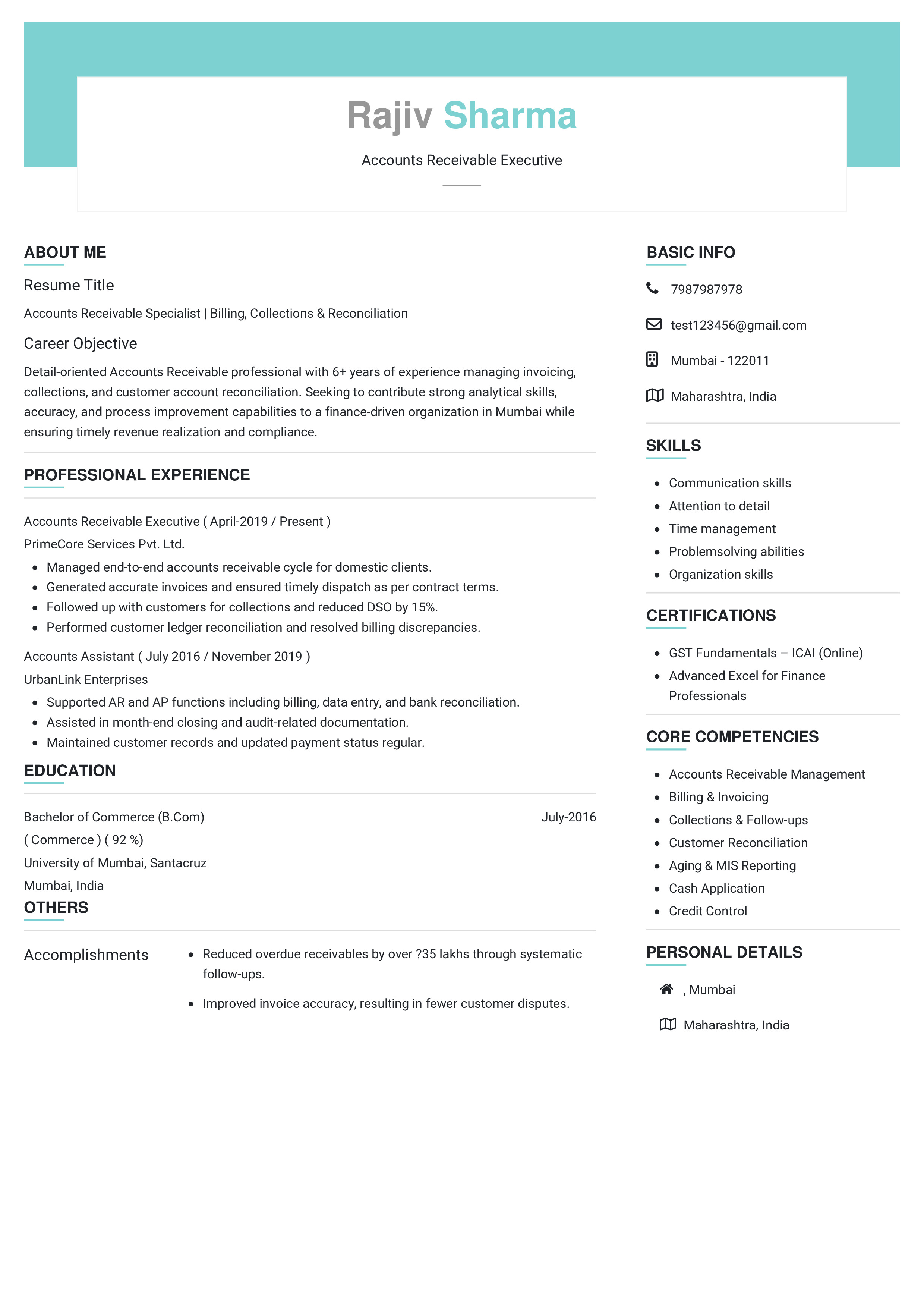
Enhance your career opportunities with an outstanding accounts receivable resume. Serving as the guardians of an organization's cash flow, accounts receivable professionals are essential in upholding financial health and stability. This detailed guide offers customized accounts receivable resume examples designed to assist you in effectively presenting your skills and experience. Regardless of whether you are an entry-level applicant or an experienced professional, these examples and expert advice will enable you to craft a resume that attracts the interest of hiring managers and aids you in securing your ideal job.
What Should Be Emphasized in an Accounts Receivable Resume?
Your resume must reflect your grasp of accounting principles along with your exceptional record-keeping abilities. Employers will be particularly interested in any experience you have with bookkeeping, auditing, account reconciliation, cash flow management, and managing customer accounts.
Additionally, it is important to showcase your expertise in specialized software for spreadsheets and financial reporting. Concentrate on the skills and duties outlined in the job description and customize your resume to align with them.
Structure of an Accounts Receivable Resume
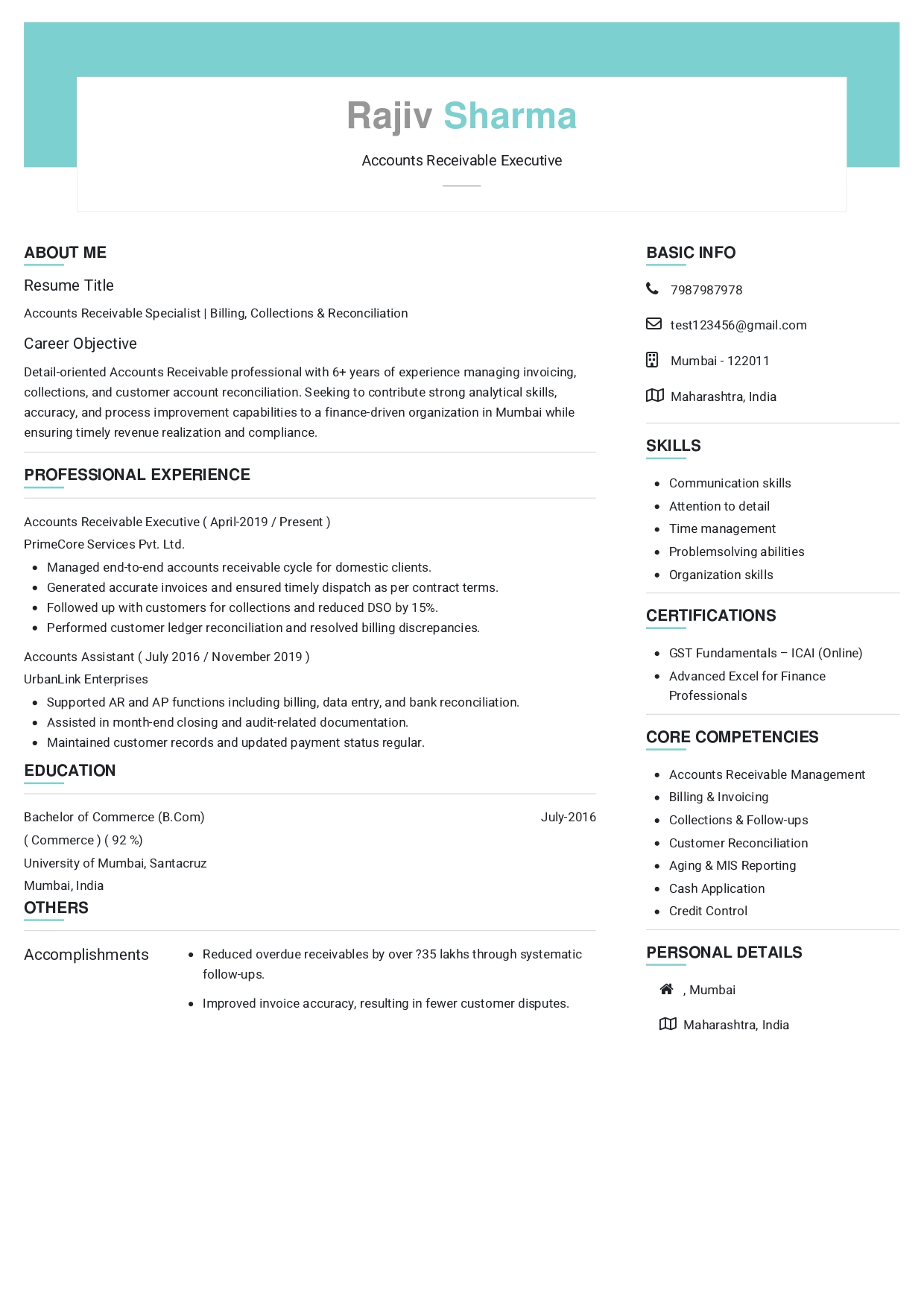
The layout of your accounts receivable resume will differ based on the resume format you select. There are three choices:
- Chronological: This format highlights work experience.
- Functional: This format concentrates on skills.
- Combination: This format integrates both skills and work experience.
The chronological format is favored by the majority of hiring managers. It is also the format utilized in the accounts receivable resume example provided below. Regardless of the format, your resume will include these sections:
How to write accounts receivable resume?
1. Contact Details
Include your contact details in the header of your resume. This should encompass your:
- Complete name
- Professional email address
- Telephone number
- City and state of residence
- Link to your professional profile, such as your LinkedIn profile
Ensure that this information is presented clearly, allowing the recruiter to reach you without difficulty.
2. Resume summary or objective
The resume summary or objective offers a concise overview of your skill set. A summary for accounts receivable resume highlights your essential skills and experiences. Conversely, objective for accounts receivable resume serves a similar purpose but additionally articulates your career aspirations. If you possess several years of experience in accounting, a resume summary would be the most effective choice.
3. Skills
Utilize the skills section to customize your resume according to the requirements of the position. Carefully review the job description and identify several desirable skills to incorporate into this section. Soft skills associated with the position of accounts receivable officer encompass:
- Communication (both written and verbal)
- Time management
- Organizational abilities
- Problem-solving
- Interpersonal skills
Your primary emphasis should be on hard skills that are specific to the role, including:
- Data entry
- Bookkeeping
- Budgeting
- Invoice processing
- Software proficiency, such as Microsoft Excel and QuickBooks
4. Work history
The work experience section provides context for your skills. Enumerate all job titles you have held in the past ten years, arranged in reverse chronological order. For each role, outline the tasks and responsibilities that are most pertinent to the position you are applying for, using bullet points. Ensure your sentences are succinct. Employ action verbs (e.g., "Managed," "Implemented") and incorporate actual examples from your previous employment. For example, you might reference key performance indicators such as your Days Sales Outstanding (DSO) or Collection Effectiveness Index (CEI).
5. Education
Please indicate your most significant academic accomplishment in this section (for instance, a master’s or bachelor’s degree in accounting). Additionally, you may incorporate pertinent certifications in this area.
Guidelines for Crafting a Resume That Captivates Attention
You can utilize the following guidelines for resume writing that capture the interest of hiring managers:
- Incorporate keywords from the job description. Including only pertinent keywords enhances the scannability of your resume. This can increase your visibility to the tracking systems that numerous companies employ to assist hiring managers in evaluating your resume.
- Be prepared to provide a reference. Check if your former employers or colleagues can offer a reference regarding your qualifications as an accounts receivable professional. Additionally, consider obtaining a reference from a current employee at the organization you wish to join.
- Review the resume thoroughly. Carefully proofread your resume to identify any typographical, spelling, or grammatical mistakes. Request a friend or family member to review it, as they may spot errors you overlooked during your initial review.
- Compose a cover letter. A significant number of employers prefer to receive a cover letter alongside a resume. Tailor your cover letter to align with the specific position and organization you are applying to, rather than relying on a generic template.
What do recruiters seek in your resume?
-
Proof of expertise in accounts software and systems.
-
Background in billing, invoicing, and managing overdue accounts.
-
Comprehensive knowledge of credit controls and risk management strategies.
-
Established capability to reconcile accounts and address discrepancies.
- Meticulous with a solid history of precise and prompt accounts receivable reporting.
Common mistakes to avoid when writing an AR resume
-
Include your GPA. If your college GPA is not exceptionally high, there is no justification for including it on your resume.
-
Avoid using passive language. Employing action verbs such as "created", "collected", and "organized" conveys authority and presents your accomplishments in the most favorable manner.
- Neglect to proofread. Even the slightest error in spelling, grammar, or formatting may result in the hiring manager rejecting your application.
Conclusion
Advance your AR career with a resume that distinguishes you from the competition. Utilize the JobsCruze Resume Builder to swiftly craft a refined, ATS-compatible resume within minutes. SignUp with JobsCruze today to construct your professional resume and enhance your likelihood of securing employment with JobsCruze!
FAQ’s
Q1. Is it necessary to include a cover letter when applying for an accounts receivable job role?
A. Unless the employer specifically states otherwise, it is advisable to always include a cover letter with your application for an accounts receivable job. This document allows you to elaborate on your key skills and experiences in more detail. Additionally, the cover letter serves as an excellent opportunity to customize your application to align with the specific requirements of the position.
Q2. How can I create an accounts receivable resume with no experience?
A. It is still possible to craft an effective accounts receivable resume even if you do not have extensive professional experience. In such cases, concentrate on any extracurricular activities, such as volunteering or internships, that demonstrate relevant skills. If you do not possess this type of experience, then it is advisable to place a stronger focus on the skills and education sections of your resume.
Q3. How should I modify my accounts receivable resume for different job applications?
A. It is essential to tailor your accounts receivable resume for each position you apply for. Begin by rewriting your resume summary or objective to align with the specific needs of the role and the goals of the organization. Next, update your accounts receivable skills and responsibilities to incorporate some of the necessary skills and qualifications mentioned in the job description.