


Table of Contents
▼- Research Analyst Resume Example & Writing Guide
- What is the role of a research analyst in an organization?
- How to compose a resume for research analyst?
- 1. Examine the job listing for the research analyst position
- 2. Select a layout and format for your resume
- 3. Provide Your Contact Information
- 4. Create a professional analyst resume summary
- 5. Share details about your work experience
- 6. Enumerate Essential Skills
- 7. Discuss your educational qualifications
- 8. Edit and Revise Your Resume
- Concluding Remarks
- FAQ’s
- Q1. Should I attach a cover letter to my research analyst resume?
- Q2. What soft skills are crucial for research analysts?
- Q3. I am making a transition from a different field. What is the best way to emphasize my experience?
- Q4. What is the appropriate length for a resume of a research analyst?
Research Analyst Resume Example & Writing Guide
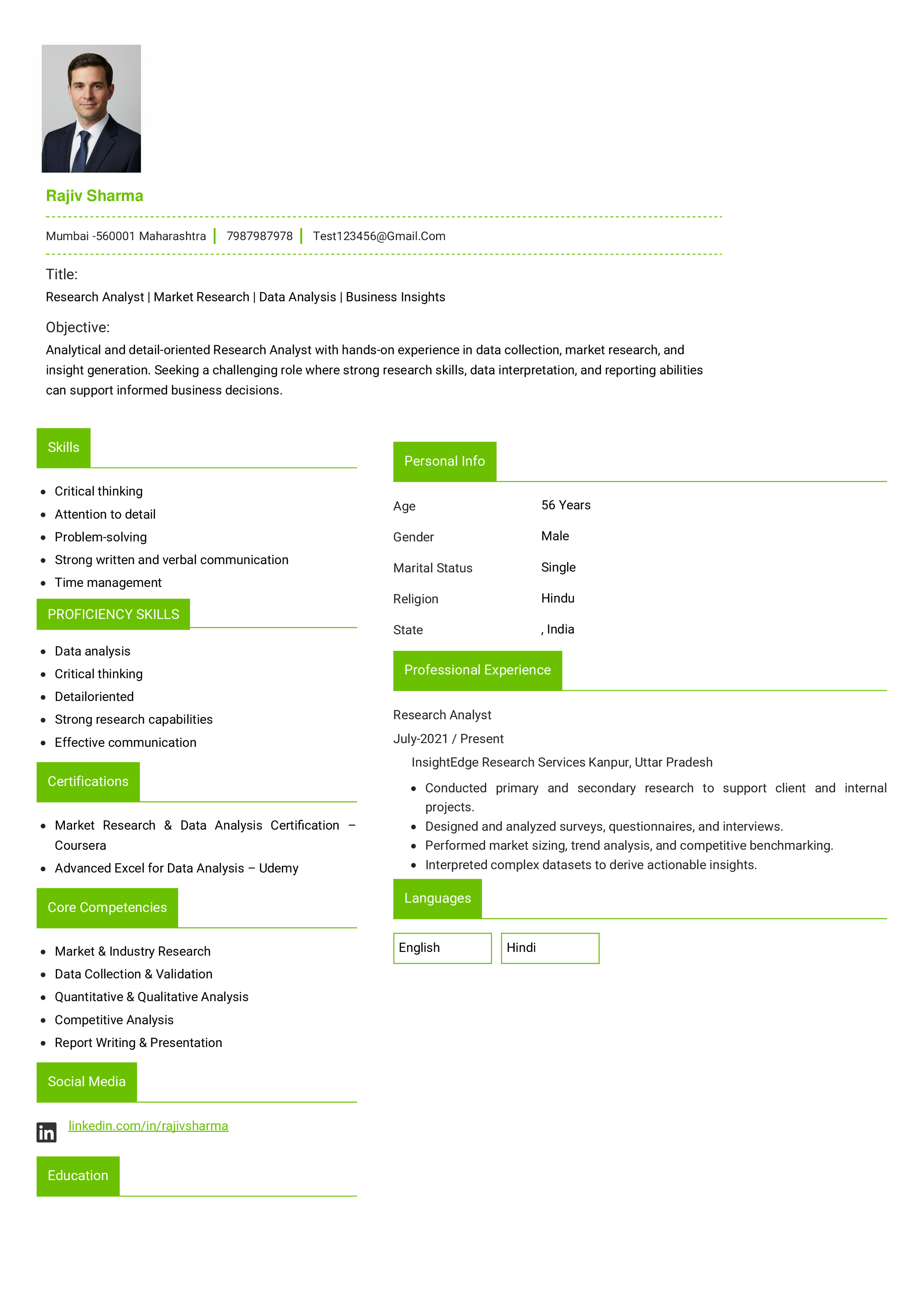
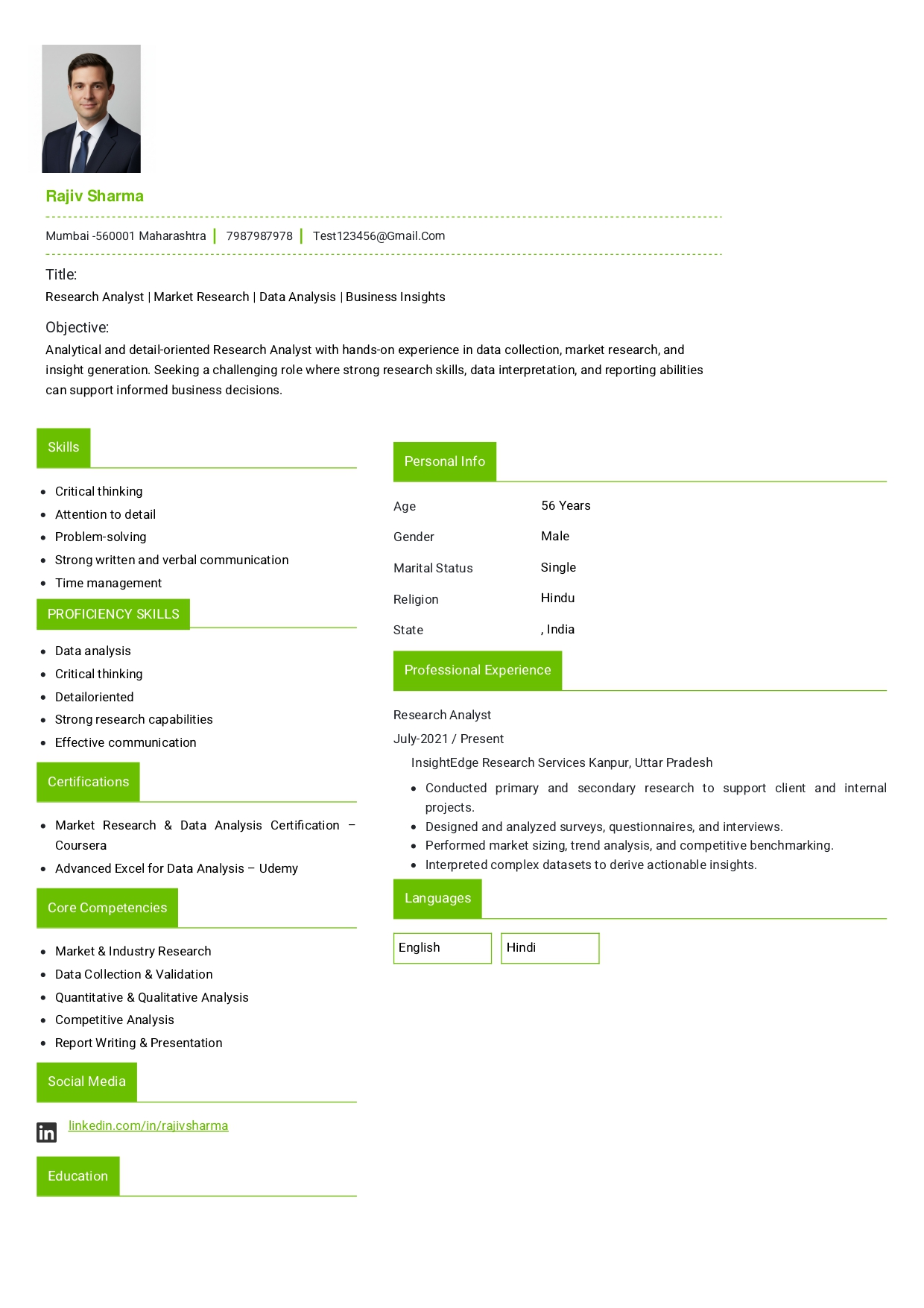
Exploring data, yet your resume fails to reflect the insights you have discovered? Reveal a more defined career path with this Research Analyst resume example, crafted using the JobsCruze resume builder for free. Recognize how seamlessly you can integrate your analytical skills to match job requirements, setting the stage for significant professional advancement!
What is the role of a research analyst in an organization?
A Research Analyst is tasked with the responsibility of conducting research and analyzing data to guide business decisions. They employ various techniques for data analysis, including statistical analysis, forecasting, and qualitative analysis, and may utilize specialized software as well. Research Analysts generally present their findings to senior management or other stakeholders and may be requested to provide recommendations based on their research. They can be found working across multiple industries, including finance, marketing, and healthcare, and may engage with both internal and external data.
How to compose a resume for research analyst?
Similar to a carefully designed algorithm, your resume as a Research Analyst should accurately showcase your abilities and analytical skills to interpret data-driven insights. Envision your resume as a tactical framework, clearly outlining your path in the constantly changing field of research analysis.
1. Examine the job listing for the research analyst position
Prior to crafting your research analyst position resume, it is advisable to examine the job listing and pinpoint the qualifications that the hiring manager seeks in a candidate. For instance, the job listing may indicate that the preferred candidate possesses at least three years of experience in the field, along with outstanding organizational and communication abilities. Emphasizing these qualifications on your resume can significantly impress the hiring manager. During your review, compiling a list of the key qualifications to incorporate can assist you in ensuring that you include as many as possible.
2. Select a layout and format for your resume
It is crucial to select a resume layout that emphasizes your strengths as a candidate for the research analyst position. If you are uncertain about which layout to adopt, you may examine the job listing to understand what the hiring organization seeks in a candidate. For instance, if the job listing indicates that the ideal candidate possesses five or more years of experience as a research analyst, opting for a layout that showcases your experience would be advantageous.
3. Provide Your Contact Information
Begin your resume for a research analyst position by including your contact information to facilitate easy communication with the hiring manager. It is essential to use bold formatting for your name and degree type in this section, allowing the reader to swiftly recognize the owner of the resume. You may incorporate the following details:
- First and last name
- Degree or certification, if relevant
- Phone number
- Email address
- City and province or territory of residence
4. Create a professional analyst resume summary
You may follow your contact information section with a professional summary that articulates why you are likely to succeed in the position. It is advisable to start your summary with a powerful adjective relevant to the profession, such as organized or detail-oriented. By sharing your pertinent qualifications, including years of experience, skills, and professional achievements, you provide crucial information to the hiring manager that aids in determining if you are a strong candidate. For instance, if you received an award at your last job, it would be beneficial to include it in your summary.
5. Share details about your work experience
Subsequently, you may enumerate two or three recent positions you have held that could enhance your qualifications as a research analyst. If you have previously worked in this capacity within a different sector, you should consider listing comparable responsibilities to those associated with the position for which you are applying. It is crucial to provide this information for each job you mention:
- Job title
- Employment dates
- Organization name
- City and province or territory of the organization
- Five experience items for your most recent position and three experience items for other roles
6. Enumerate Essential Skills
Following the completion of your work experience section, you may wish to emphasize the skills that will enable you to thrive as a research analyst. Generally, job postings outline specific skills that the employer seeks in the perfect candidate. Below are some skills required for research analyst:
- Capacity To Perform Under Pressure
- Meticulous Attention To Detail
- Effective Communication Abilities
- Proficiency In Data Auditing
- Skills In Materials Coordination
- Strong Organizational Capabilities
- Expertise In Quality Control
- Skills In Research Project Design
- Software Programming Proficiency
- Statistical Modeling Expertise
7. Discuss your educational qualifications
In this segment, you may emphasize your academic credentials, including any degree you have obtained that pertains to the research analyst position. Numerous employers expect applicants to possess a minimum of a bachelor's degree in statistics, economics, mathematics, social science research, or a similar discipline.
8. Edit and Revise Your Resume
Once you have completed your resume, allocate time to edit and revise it to guarantee that it is devoid of misspellings, awkward phrasing, and grammatical errors. You may utilize an online tool to verify your document for mistakes. Prior to submission, it may be beneficial to have a friend or family member examine the document. They might identify an error you overlooked or provide a valuable suggestion. When you are assured that it is free of errors, you can proceed to submit it to the hiring organization. Reviewing the job listing can help ensure that you adhere to the instructions during this phase.
Concluding Remarks
This guide simplifies your journey towards creating an exceptional Research Analyst resume. JobsCruze's resume builder online is essential for developing a resume that highlights your distinct strengths and experiences while ensuring compatibility with ATS. Start with a template that is friendly to ATS, or create your own from the ground up. Use an ATS resume scanner to validate your output and increase your chances of securing an interview. Your resume transcends being just a document; it represents your analytical skills, vividly illustrated for the next phase of your career. Refine it, customize it, and prepare yourself for success.
FAQ’s
Q1. Should I attach a cover letter to my research analyst resume?
A. Certainly. A cover letter serves as an effective instrument that enables you to highlight your distinct qualifications and passion for the role. It enhances your resume and facilitates a personal connection with hiring managers.
Q2. What soft skills are crucial for research analysts?
A. Skills such as critical thinking, collaboration, and effective communication are vital for research analysts. These interpersonal abilities enhance teamwork and facilitate the clear presentation of complex findings, resulting in improved decision-making and stronger relationships with colleagues and stakeholders.
Q3. I am making a transition from a different field. What is the best way to emphasize my experience?
A. Emphasize transferable skills and experience, such as analytical thinking, communication, and project management that you have developed in your previous positions. These competencies showcase your capability to succeed as a research analyst, despite not having direct experience in this area. Provide specific examples from your past accomplishments to demonstrate how these skills are relevant to data analysis and reporting responsibilities.
Q4. What is the appropriate length for a resume of a research analyst?
A. For individuals in the research analyst field, the length of the resume may differ depending on their level of experience. Generally, a one-page resume is adequate for those who are new to the profession or possess less than 10 years of experience, as it allows for a concentration on essential skills such as data analysis and significant projects. Conversely, for those with considerable experience or advanced degrees pertinent to research analysis, a two-page resume could prove advantageous. It is important to ensure that every detail included reinforces your analytical skills.